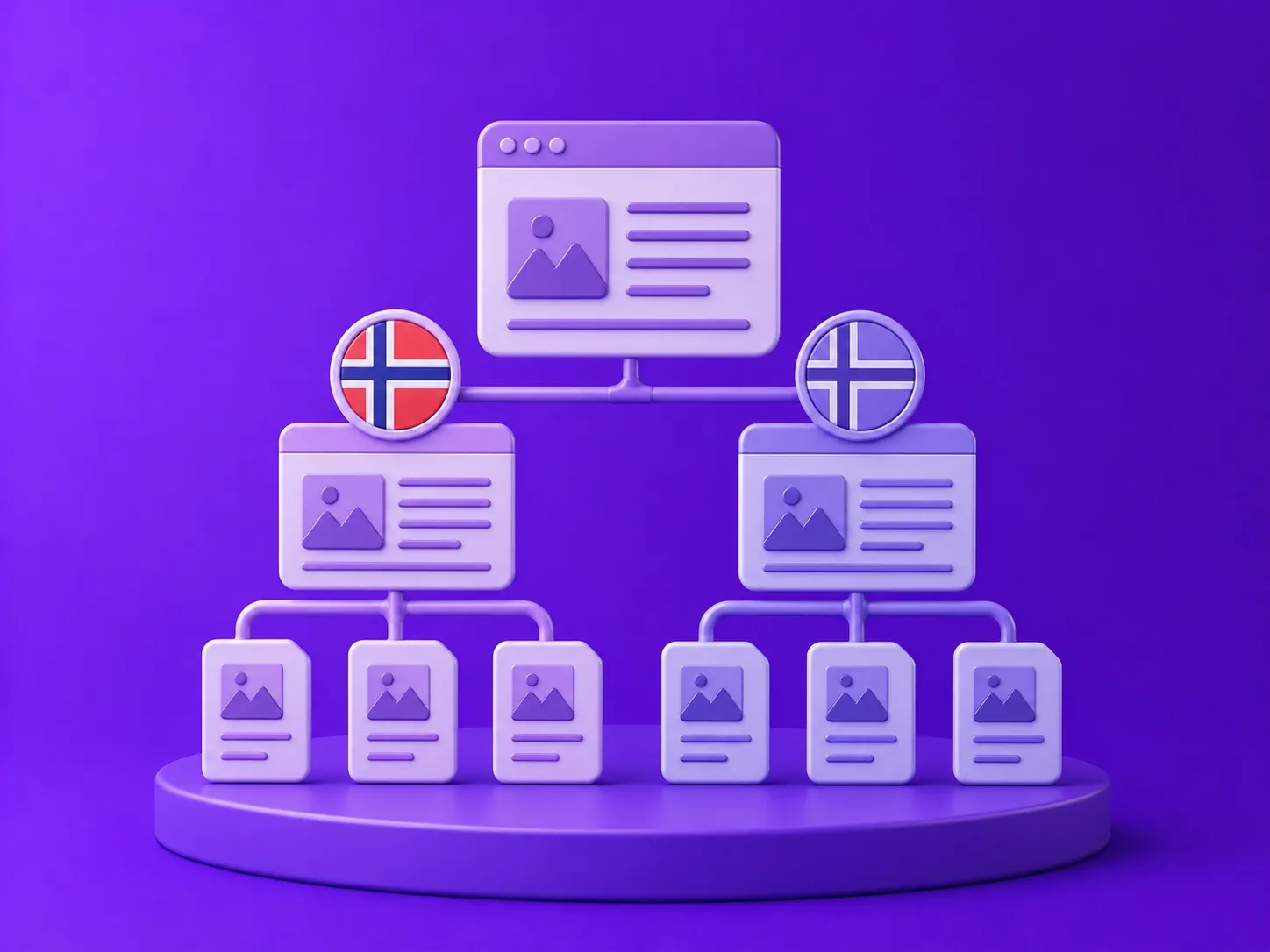
A content page built to be cited by AI engines in Norway needs a specific architecture: a bilingual entity-definition lead paragraph, an FAQ block with 40-to-80-word answers marked up as FAQPage schema, modular 134-to-167-word passages under question-based H2 headings, and a deliberate split between what runs in Bokmål first and what runs in English first. None of this is generic international SEO advice relabelled; each element responds to a specific, evidenced Norwegian condition covered in this article.
What Does a Citable Page Architecture Actually Look Like?
Academic and practitioner research converge on a consistent structural pattern for AI-citable content. The AutoGEO research framework found that AI engines reward structured, machine-scannable content over promotional or keyword-stuffed writing, and that this preference is stable and domain-agnostic, meaning the same structural rules apply whether the topic is accounting software or offshore wind maintenance. The foundational GEO paper (arXiv 2311.09735, published at ACM SIGKDD 2024) established a systematic AI-search bias toward earned, third-party media over brand-owned content, a point that shapes the earned-media section later in this piece.
Ten elements make up a complete build, in the order a content team should actually work through them: an entity definition block, an FAQ architecture with schema, a modular paragraph structure, a direct-answer convention at the top of each section, a full schema markup stack, a bilingual URL and hreflang architecture, an earned-media and digital-PR programme, Wikipedia and Wikidata entity presence, technical crawlability for AI bots, and a defined Bokmål-versus-English content split by category. The rest of this article works through each in turn.
Entity Definition Block: Why the Lead Paragraph Matters Most
Every page should open with a clear, self-contained definition: who the organisation is, what it does, for whom, and in what geographic market, stated in the first paragraph rather than built up to gradually. For Norwegian clients targeting AI engines for local queries, that definition should exist in both Norwegian and English, since LLMs may query, and retrieve, in either language depending on how a buyer phrases their question. A practical template: state the entity, category and market in Norwegian first ("[Organisation name] er [kategori/tjeneste] i [by/region], Norge, og leverer [verdi] til [målgruppe]"), followed immediately by the English equivalent, rather than relegating the English version to a separate page that an AI engine may never connect back to the Norwegian one.
FAQ Architecture: The 40-to-80-Word Rule
FAQPage schema in JSON-LD is directly machine-readable by every major AI engine, which makes FAQ sections one of the highest-leverage structural elements on a page. The optimal answer length, consistent across GEO practitioner guidance, is 40 to 80 words per answer: long enough to be self-contained and quotable, short enough that an AI engine can lift the full answer into a generated response without truncation. Questions should mirror how a real buyer actually phrases a query inside a chat window, including Norwegian-language variants of common industry questions, structured around patterns like "Hva er...?", "Hvordan håndterer [selskap]...?", "Hva koster...?" and "Er [selskap] GDPR-kompatibelt?", the same query shapes a Norwegian business buyer actually types.
The Citable Content Block, Section by Section
A question-based, natural-language heading matching how a buyer actually asks, in Bokmål or English depending on the target query.
Immediately following the heading: a self-contained, factual summary with zero introductory filler or hedging language.
Sourced statistics, named experts and verifiable numbers, sized to match standard LLM retrieval chunk lengths for easier extraction.
JSON-LD schema (Article, FAQPage, Organization) tying the passage back to a verifiable, consistently-named entity.
Pattern synthesised from AutoGEO research (2025), the foundational GEO paper (arXiv 2311.09735, ACM SIGKDD 2024), and cross-validated GEO practitioner guidance on modular paragraph sizing for LLM retrieval.
Two independently sourced statistics quantify why this technical layer matters more than it might appear to. Semrush found that GPT-4's information-extraction accuracy on a page jumped from 16% to 54% once proper schema markup was in place, a three-times difference driven purely by structure, not content quality. Separately, a 2025 analysis of 10,000 AI citations (Kime.ai) found that answer-first passages of 40 to 75 words were cited 3.1 times more often than longer passages, a close match to the 40-to-80-word FAQ convention and the 40-to-55-word direct-answer rule already covered in this article, arrived at through an independent methodology.
Bokmål vs Nynorsk vs English: Which Content Goes Where?
A bilingual strategy should never mean direct translation of one master version into another; it means deliberately assigning different content types to different languages based on audience and citation behaviour, covered in depth in our companion article on Norwegian versus English AI citation sources.
| Content Type | Norwegian (Bokmål) First | English First |
|---|---|---|
| Service pages | Local service and transactional pages | International expertise and category pages |
| Regulatory content | Norwegian regulations and standards | Global research and thought leadership |
| Case studies | Local case studies and testimonials | Export-oriented case studies |
| Commercial FAQs | Norwegian pricing and procurement questions | Technical documentation and comparison content |
| FAQ terminology | Bokmål FAQs reflecting local terminology | English FAQs reflecting global terminology |
| Media citations | Norwegian media and industry citations | International media and specialist citations |
Bokmål should normally be the first Norwegian target given its broader population share and consistently stronger model performance in current research. Nynorsk is added deliberately, where audience geography, public-sector obligations, publishing policy or brand positioning specifically justify it, rather than as a default parallel build for every page.
URL and hreflang Architecture for a Bilingual Site
Separate URL paths for Norwegian and English content (typically /no/ and /en/) with correct hreflang annotation let both search engines and AI crawlers understand that two pages represent the same entity in different languages, rather than treating them as duplicate or unrelated content. Entities should be referenced consistently across both language versions within the same structured data, so an AI engine indexing the Norwegian page and the English page can resolve them to the same underlying Organization entity rather than two separate, weaker ones.
Schema Markup Stack for Norwegian Entities
A complete schema implementation for a Norway-facing entity includes six components working together, each doing a specific job in helping AI engines and Google's Knowledge Graph resolve exactly who a brand is and what it does.
The Six-Part Norwegian Entity Schema Stack
Organization
sameAs links to Wikidata, LinkedIn, Brønnøysundregistrene
FAQPage
All structured Q&A sections, 40-80 word answers
Article
author, dateModified, datePublished fields set
BreadcrumbList
Navigational clarity for crawlers and users alike
Product / Service
Price range and currency stated in NOK
LocalBusiness
Where a genuine Norwegian office presence exists
The Organization schema's sameAs links deserve particular care for a Norway-facing entity: linking to Brønnøysundregistrene, Norway's central business registry, alongside Wikidata and LinkedIn, gives an AI engine a verifiable, government-backed anchor for entity resolution that a purely international schema build would miss entirely.
What Does a Real Entity Definition Look Like in Practice?
The difference between a weak and a strong lead paragraph is concrete enough to show side by side. A weak version reads like marketing copy without an anchor: "We help businesses grow their online presence and reach new customers through innovative digital strategies." An AI engine extracting that paragraph learns almost nothing verifiable, no category, no geography, no specificity. A strong version states the entity plainly: "[Organisation] is a [specific service category] provider based in [city], Norway, serving [named audience] with [specific, named service]." The second version gives an AI engine four extractable facts in one sentence; the first gives it none. This distinction sounds obvious once stated, yet it is the single most common structural weakness across the Norwegian websites reviewed in the course of this research.
What Does a Structural Rebuild Actually Involve, Start to Finish?
Rebuilding an existing Norwegian website's content architecture around these principles is not a single sprint; it follows a realistic sequence across roughly three phases.
Phase one, typically four to six weeks, is audit and foundation: an entity and schema audit across the existing site, a content inventory sorted by the Bokmål-versus-English framework covered above, and technical crawlability fixes (robots.txt, sitemap.xml, Core Web Vitals). Nothing customer-facing changes yet; this phase is entirely structural groundwork. Phase two, typically eight to twelve weeks, is the content rebuild itself: rewriting priority pages with the entity-definition-lead-paragraph pattern, building out FAQPage-schema-marked question sections at 40-to-80 words per answer, and restructuring long-form content into the 134-to-167-word modular passage format. Priority order matters here: pages already receiving meaningful traffic or sales-team attention should be rebuilt before low-traffic pages, since citation gains compound faster on pages an AI engine already has some reason to retrieve. Phase three, ongoing rather than time-boxed, is the earned-media and measurement layer: digital PR placement, Wikipedia and Wikidata entity work, and the prompt-panel citation tracking described in our companion article on measuring GEO ROI in NOK.
A realistic expectation, consistent with GEO citation timelines generally, is that the first measurable citation-rate movement appears two to three months after phase two content begins publishing, not immediately after the phase one technical work, since AI engines need to index and then retrieve the new structure before it shows up in citation tracking at all.
What Structural Mistakes Most Often Undermine Citability?
Four mistakes recur often enough across Norwegian sites reviewed for this research to name specifically. The first is machine-translating a single master version instead of building genuinely separate Bokmål and English content strategies; a direct translation carries over sentence structures and idioms that read as slightly foreign in the target language, which both human readers and, per University of Oslo's own model-performance research, AI systems themselves seem to weight negatively. The second is burying the entity definition three or four paragraphs into a page after a scene-setting introduction, rather than opening with it directly. The third is writing FAQ answers as marketing copy rather than direct answers, hedging with phrases like "it depends" or "we can help with that" instead of the specific, extractable 40-to-80-word answer AI engines need. The fourth is treating schema markup as a one-time technical task rather than a maintained asset, letting Organization details, pricing, or entity names drift out of sync with the actual page content over time, which erodes exactly the kind of consistency AI engines rely on for entity resolution.
Technical Crawlability for AI Bots
Three checks matter more than any single trending tactic. First, confirm no robots.txt disallow rules are blocking the common AI crawlers: GPTBot, Google-Extended, ClaudeBot and PerplexityBot. Second, keep sitemap.xml current and submitted to both Google Search Console and Bing Webmaster Tools. Third, prioritise Core Web Vitals and clean, fast-loading HTML; AI bots weight simple, quickly-parsed pages more heavily than JavaScript-heavy single-page applications that require rendering before content becomes visible.
On llms.txt specifically: this newer plain-text standard is worth deploying as a clean developer convention, but it should not be sold or treated as a meaningful citation lever. Roughly 844,000 sites had adopted an llms.txt file by early 2026, and independent SEO analyst Kevin Indig's own assessment is blunt: it is "a good idea that lacks confirmed impact," worth adding because it is low-cost, not because it is proven. A controlled 90-day OtterlyAI experiment tracking more than 60,000 AI crawler visits found requests for llms.txt accounted for just 0.1% of total bot hits, with no measurable change in crawl prioritisation, and Google has stated directly that the file is unnecessary for appearing in its generative search features. Deploy it as lightweight infrastructure if convenient; do not present it to a Norwegian client as a ranking or citation strategy.
Content freshness deserves its own line item alongside crawlability. Perplexity and Google AI Overviews both weight recency in what they retrieve, and updating a page's core content and its dateModified field on a roughly 90-day cycle is a practical minimum for pages a client actively wants cited. One published study found that updating schema markup alone, independent of any content change, delivered a median citation lift of approximately 22%, a reminder that the technical layer and the content layer both decay if left untouched.
Does This Architecture Serve Google SEO and AI Citation at the Same Time?
Largely yes, and that overlap is worth being explicit about, because it changes how a Norwegian business should think about sequencing this work against an existing SEO programme. Clean semantic HTML, fast Core Web Vitals, consistent entity naming and a maintained schema stack all help traditional Google ranking as much as they help AI citation; none of the technical foundation described in this article is GEO-exclusive. The genuinely GEO-specific layer sits on top of that shared foundation: the 40-to-80-word FAQ answer convention, the modular 134-to-167-word passage sizing, and the deliberate earned-media weighting all respond specifically to how AI engines extract and synthesise content, rather than how Google ranks a page in a list of ten blue links.
The practical implication for a Norwegian business already running an SEO programme is that this architecture is additive, not a replacement project. A site with strong existing technical SEO and weak entity/FAQ structure needs primarily the GEO-specific layer; a site with neither needs the full rebuild sequence described above. Our companion service page for SEO in Norway covers the technical-SEO foundation this article assumes is already in place or being built alongside it, since AI engines still source the large majority of their answers from indexed, crawlable web content in the first place; a page with poor Google visibility rarely gets discovered for AI citation either, regardless of how well it follows the structural patterns in this article.
Earned Media and Third-Party Citation Strategy
Because AI systems demonstrably prioritise earned, third-party media over brand-owned content, per the foundational GEO paper referenced earlier, a Norwegian GEO build needs a deliberate earned-media programme, not just an owned-content calendar. That means press-release distribution through Norwegian newswires (NTB and comparable services) and relevant industry publications; expert commentary placement in outlets Norwegian AI engines and buyers actually recognise, such as Dagens Næringsliv and Kampanje, alongside category-relevant trade press; a consistent Wikipedia entity presence with matching Wikidata records; and thought-leadership content under named executives on platforms like LinkedIn Pulse, which function as author-level E-E-A-T signals that structured data alone cannot fully replicate.
Our book Cited or Silent covers the full earned-media playbook this section summarises, including how to sequence digital PR alongside the technical and content work described throughout this article rather than treating it as a separate, later-stage activity.
Frequently Asked Questions
Should every page on a Norwegian site have both a Norwegian and an English version?
Not necessarily every page, but every page should have a clear language strategy decision behind it. Locally-anchored service and transactional content should lead in Bokmål; internationally-benchmarked, export-facing or comparison content should lead in English. The goal is a deliberate split by content type and audience, not a blanket bilingual duplication of every page.
What's the ideal length for an FAQ answer meant to be cited by an AI engine?
40 to 80 words. Long enough to stand alone as a complete, useful answer; short enough that an AI engine can extract the full answer into a generated response without needing to truncate or summarise it further, which reduces the risk of the AI engine paraphrasing your answer inaccurately.
Is llms.txt worth implementing for a Norwegian GEO strategy?
As a clean, lightweight developer standard, yes, there is little downside. As a citation or ranking lever, no; a controlled 90-day study found it accounted for just 0.1% of AI crawler traffic with no measurable impact on crawl prioritisation, and Google has stated it is unnecessary for its own generative search features. Core semantic HTML and schema markup do the actual work.
Why does Brønnøysundregistrene matter for schema markup specifically?
It is Norway's central, government-run business registry, and linking a client's Organization schema to their Brønnøysundregistrene record gives AI engines and Google's Knowledge Graph a verifiable, authoritative anchor for entity resolution, one that a schema build using only international registries (Wikidata, LinkedIn) would lack for a Norway-specific business.
How does this content architecture differ from a standard international SEO content template?
The structural elements (entity definitions, FAQ schema, modular passages) are broadly consistent with GEO best practice anywhere. What differs is the specific evidence behind each Norwegian decision: the Bokmål-first default is grounded in population share and documented model-performance gaps; the bilingual split by content type is grounded in citation-behaviour research; and the Brønnøysundregistrene schema link and NTB/Dagens Næringsliv earned-media targets are Norway-specific rather than generically international.
Sources & References:
- AutoGEO research framework, arXiv (2025) (structured content preference in AI engines)
- "GEO: Generative Engine Optimization," arXiv 2311.09735, presented at ACM SIGKDD 2024 (earned-media citation bias, foundational GEO methodology)
- Semrush, schema markup and GPT-4 information-extraction accuracy study (16% to 54% lift); Kime.ai, 2025 analysis of 10,000 AI citations (40-75 word passage citation rate)
- GEO practitioner guidance on FAQ schema and modular paragraph sizing for LLM retrieval (40-80 word FAQ answers, 134-167 word passage sizing)
- University of Oslo, Norwegian question-answering benchmark research (Bokmål vs Nynorsk population and model-performance data)
- OtterlyAI, 90-day controlled llms.txt crawl-traffic study (0.1% of AI bot hits); Kevin Indig, independent SEO analysis on llms.txt adoption and impact
- Brønnøysundregistrene, Norway's central business registry (entity verification anchor for schema markup)
This article provides general content-architecture guidance; specific implementation should be adapted to each site's existing technical infrastructure and content management system.