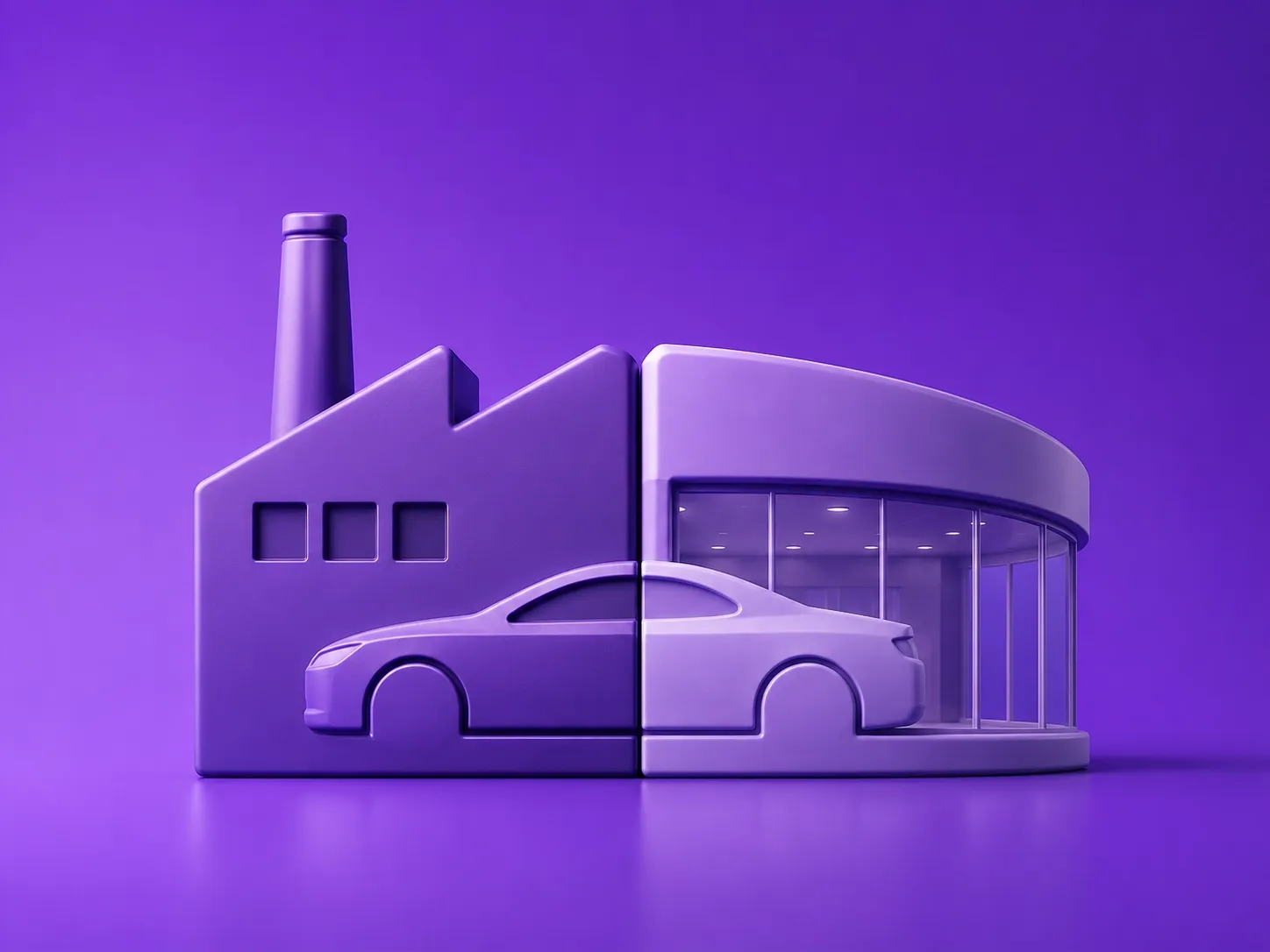
An automotive manufacturer's national site and its own dealer network's local pages are, structurally, positioned to compete against each other for identical keywords. Nobody designed it that way on purpose. It happens by default whenever a dealer copies manufacturer specification copy onto a local page, and Google, seeing near-duplicate content on two ranking domains under related ownership, has no reason to reward either.
This is not a hypothetical risk. Practitioner guidance across multiple automotive SEO sources converges on the same warning, phrased almost identically each time: "original content works better for automotive SEO than manufacturer descriptions," and dealers are told plainly not to reuse generic OEM copy but to build local content that speaks to their own market instead. The advice is repeated often enough, across enough independent sources, that the underlying failure pattern is clearly common, not rare.
Why the Conflict Exists in the First Place
Automotive marketing operates across three tiers, a structure documented consistently across Forbes Agency Council, AutoSuccessOnline, TEGNA and Demand Local's tier-alignment literature: Tier 1 is the OEM or manufacturer at the national level, Tier 2 is the regional dealer association or co-op sitting in between, and Tier 3 is the individual local dealer at the base. Each tier has a natural content territory. The manufacturer owns brand-level model content, national specification sheets and campaign messaging. The regional co-op typically coordinates promotional campaigns and inventory positioning across a defined region, a layer many single-market discussions of this problem skip past entirely. The dealer owns local, transactional intent: "near me," current inventory, local pricing and service capacity. In principle the three should never overlap. In practice, a dealer under time pressure pastes the manufacturer's model description onto their own site because writing original copy for every model in inventory is slow, and the manufacturer, for its part, sometimes builds out local-sounding pages of its own without coordinating with the dealer network beneath it.
The tier-alignment and co-op advertising literature is explicit about what happens when this coordination fails, even outside the SEO context specifically: misaligned messaging across tiers causes compliance rejections, wasted ad spend and inconsistent messaging, per Demand Local's own description of the problem. The SEO-specific version of that same failure is keyword cannibalisation: two related domains, sometimes even sharing backlink profiles or technical infrastructure, both targeting a query like "Toyota Avanza 2026 review," neither clearly winning, both diluting the authority the brand could have concentrated in one place. The underlying cause, tiers failing to agree on who says what, where, is the same in both cases; SEO cannibalisation is simply the organic-search symptom of a coordination problem the advertising and compliance side of the business has already been documenting for years.
Manufacturer / OEM
- National model pages and specification databases
- Brand-level informational and comparison content
- Safety ratings, warranty terms, national campaigns
- Canonical product data feed for the whole network
Dealer
- Local inventory, current stock and pricing
- "Near me" and city-plus-model queries
- Test-drive booking, staff, service capacity
- Local reviews, directions, Google Business Profile
The Coordination Failure Nobody Publishes Data On
Here is an honest gap in the research: no public source documents exactly how Indonesian OEM principals such as Toyota Astra Motor or Astra Daihatsu Motor formally divide SEO responsibility with their own dealer networks. What exists instead is a well-documented general framework (the tiered ownership model above) plus a repeated warning about the specific failure mode, without a published Indonesian case study walking through how any single brand actually resolved it. Any specific process recommendation for the Indonesian market is, at this point, an informed inference from the general pattern, not a directly sourced local fact. Treat it accordingly, and verify against your own brand's actual dealer agreements before publishing a policy as though it were settled practice.
Auto2000 as the Working Example
PT Astra International's Auto2000 network offers the clearest available illustration of the split working as intended, precisely because of its scale: Auto2000 is described as Toyota's largest founder dealer network, responsible for over 40% of the brand's national sales volume, operating beneath PT Toyota Astra Motor as the sole national agent. At that scale, a coordination failure would be expensive enough that the network has clear incentive to solve it. Auto2000's own editorial content, including direct model-comparison pieces such as its "Avanza vs Xenia" article, functions as exactly the kind of original, dealer-network-level content the practitioner guidance recommends: informative, comparison-oriented, and distinct from a manufacturer's core specification page rather than a copy of it.
A Practical Keyword Ownership Matrix
The most direct fix is deciding keyword ownership before content production starts, not after a ranking conflict shows up in Search Console. A workable split looks like this: the manufacturer takes broad brand terms, national model names, and category-level informational queries. The dealer takes every query with a city, a "near me," or a transactional modifier attached. Comparison content is the one genuinely contested middle ground, and the practical resolution is usually to let the manufacturer or its national dealer association own the primary comparison asset, while individual dealers link to it rather than rebuilding a competing version.
| Query Type | Example | Owning Tier |
|---|---|---|
| Brand/model informational | "Toyota Avanza spesifikasi 2026" | Manufacturer |
| Model comparison | "Avanza vs Xenia" | Manufacturer or national dealer association |
| Local transactional | "dealer Toyota Denpasar" | Dealer |
| Local inventory | "stok Avanza Bali" | Dealer |
| Service and maintenance | "servis Avanza 40.000 km" | Dealer, with manufacturer providing base schedule data |
The Technical Layer: AutoDealer Schema as the Connective Tissue
Beyond editorial coordination, a dealer's structured data should explicitly link back to the manufacturer's brand entity, typically through the knowsAbout or brand property inside AutoDealer schema. This does two things at once: it signals to search engines that the dealer is an authorised, franchised outlet rather than an independent reseller, and it reinforces the entity relationship search engines use to avoid treating near-duplicate content from the two tiers as a single confused source.
Audit existing overlap
Pull every dealer page ranking for a manufacturer-owned term, and every manufacturer page competing with dealer local content.
Assign ownership by tier
Use the query-type matrix above as a starting split, adjusted for your own network's actual content gaps.
Rewrite duplicated dealer pages
Replace copied OEM specification text with original local content: inventory, pricing, staff, service capacity.
Link, don't compete, on comparisons
Point dealer pages to the manufacturer's comparison asset instead of rebuilding a competing version.
Connect schema entities
Add AutoDealer-to-brand linkage so search engines read the relationship correctly, not as unrelated duplicate content.
What Changes If You Are Only the Dealer, Not the Manufacturer
Not every reader of this runs the national brand. If you operate as a single dealer or a small regional network with no influence over the manufacturer's content decisions, the practical move is simpler: never copy the manufacturer's model description onto your own site, regardless of what the manufacturer itself does. Build your local page around what only you can honestly claim, actual stock, actual price, actual staff, actual service bay capacity, and let the manufacturer's own site be the place a buyer goes for the spec sheet. That alone resolves your side of the cannibalisation risk even if the manufacturer never coordinates anything on theirs.
The One Case Where a Dealer Can Legitimately Outrank the Manufacturer
The general rule above, manufacturer owns brand-level authority, has one clear, well-documented exception worth calling out on its own: newer market entrants still building their Indonesian-language presence. Established Japanese OEM brand sites, Toyota through auto2000.co.id, Honda through astra-honda.com, Daihatsu through daihatsu.co.id, already carry strong organic authority for model-specific informational queries, built up over years. Chinese EV entrants including BYD, Wuling and Chery are, by comparison, still in comparatively early stages of building that same Bahasa Indonesia-language SEO authority.
That gap creates a genuine, time-limited opportunity for a dealer partner or agency working with one of these newer entrants: it is possible to rank for model-specific queries ahead of the manufacturer's own site during this brand-building phase, provided the content is genuinely useful rather than a copy of whatever thin material the manufacturer has published so far. The most effective way to do this is producing original, local-language content on exactly the topics a newer entrant's own site has not yet fully covered: TKDN compliance status, charging-infrastructure partnerships, and financing options specific to the Indonesian market. A dealer or agency willing to build topical authority on these fronts faster than the manufacturer itself can capture a disproportionate share of early-stage demand for that brand, a window that will not stay open indefinitely as the manufacturer's own Indonesian content matures.
How to Tell the Split Is Actually Working
Coordination is easy to declare and hard to verify. A few concrete signals separate a genuinely resolved split from one that only looks resolved in a strategy document. First, search a unique sentence from any manufacturer model description, in quotes, and check how many dealer domains return an exact or near-exact match. Zero is the target; any nonzero result is an active, not historical, cannibalisation problem. Second, check whether the manufacturer's own comparison content and a dealer's local page for the same model rank for genuinely different query variants in Search Console, rather than trading the same handful of positions back and forth month to month, which is a visible symptom of two pages competing rather than complementing each other.
Third, and most overlooked, check whether the dealer pages that stopped copying manufacturer copy actually gained rank afterward, rather than simply losing the duplicate-content penalty without replacing it with anything that ranks on its own merit. Rewriting copied content is necessary but not sufficient; the replacement content still has to be genuinely useful, specific, and current, or the dealer page ends up thin instead of duplicate, which is not really progress. Fourth, for networks large enough to run the comparison, track whether local dealer leads increased in cities where the coordination work was completed first, against cities still running the old duplicated-content structure, since that is the closest thing to a controlled test most networks can run without commissioning new research.
None of these four checks require new tooling. They require actually running the query, actually reading the Search Console data, and actually being willing to find that a "resolved" split is not resolved yet. That last part is usually the harder one.
Frequently Asked Questions
Who should own comparison content like "Avanza vs Xenia"?
Ideally the manufacturer or a national dealer association, with individual dealers linking to that asset rather than rebuilding a competing version. Where no such national asset exists, a large, well-resourced dealer network such as Auto2000 can credibly fill that gap with original comparison content of its own.
Is there a documented Indonesian example of this coordination working?
Auto2000, as Toyota's largest founder dealer network in Indonesia, is the clearest available illustration, producing original comparison editorial distinct from manufacturer spec copy. A fully documented, formal responsibility split between an Indonesian OEM and its dealer network was not found in public sources at the time of writing.
What is the fastest way to check if we already have a cannibalisation problem?
Search your own dealer network's model pages verbatim in Google, in quotes, and see how many domains return a near-identical match. Any manufacturer specification paragraph appearing unchanged across multiple dealer sites is a live cannibalisation risk, not a theoretical one.
Does AutoDealer schema actually fix a cannibalisation problem on its own?
No. It clarifies the entity relationship for search engines once the content itself is no longer duplicated, but it cannot substitute for actually rewriting copied specification text into original local content.
This split is one of six disciplines covered in more depth on our SEO for Automotive page, and the same coordination problem shows up again, in a different form, once AI citation enters the picture, which we cover in GEO for Automotive. For the underlying three-layer SEO plus GEO plus AEO model this fits into, Tessar Napitupulu's Found Before They Search lays out the fuller framework.
Want a keyword-ownership audit for your own manufacturer-dealer network? Download the free first chapters of Found Before They Search.
Sources & References:
- SeoProfy and Dealers United, automotive SEO practitioner guidance — original dealer content outperforms reused manufacturer descriptions; reported consensus across multiple independent sources.
- Forbes Agency Council, AutoSuccessOnline, TEGNA and Demand Local — the three-tier (OEM/national, regional dealer association or co-op, local retail dealer) automotive marketing structure; misaligned cross-tier messaging documented to cause compliance rejections, wasted ad spend and inconsistent messaging.
- Hrizn and A3 Brands, automotive SEO service-taxonomy research — OEM compliance constraints within the tiered marketing structure.
- Auto2000.co.id, "Avanza vs Xenia" comparison article — cited as a working example of dealer-network-level original comparison content.
- Gemini and ChatGPT SEO-taxonomy research — Chinese EV entrants (BYD, Wuling, Chery) identified as still building Bahasa Indonesia-language SEO authority relative to established Japanese OEM sites, creating a time-limited ranking opportunity for dealer partners and agencies.
- Claude SEO research — explicit caveat that no public source documents a formal Indonesian OEM-dealer SEO responsibility split.