More people now open ChatGPT before they open Google. They ask it to compare products, recommend a vendor, or explain a topic, and it answers in prose, sometimes with links to the sources it leaned on. Getting your brand into those answers, and ideally cited with a link, is the whole game. Here is how ChatGPT actually chooses what to cite, and what you can do to earn a spot, based on how the system works in 2026.
How ChatGPT Actually Picks Sources
ChatGPT runs on two layers, and the difference between them decides whether you get a passing mention or a real citation.
The first layer is its training data, a vast but static snapshot of the web learned before the model's cutoff. When ChatGPT answers from training alone, it may name your brand, but it rarely attributes or links to you. That is a mention, not a citation. The second layer is live retrieval, powered by Bing. When ChatGPT searches the web mid-answer, it pulls candidate pages, evaluates them, and cites the few it can confidently quote, usually around four sources per response, often with links. Citations happen in this retrieval layer.
Two layers, two outcomes
Layer 1 · Training data
Result: a mention. A static snapshot of the web. ChatGPT may name your brand from memory, usually without a link or attribution.
Layer 2 · Live retrieval via Bing
Result: a citation. ChatGPT searches the web mid-answer and links the few pages it trusts most. This is the layer GEO targets.
Mentions build familiarity. Retrieval earns the clickable citation.
Two facts shape everything that follows. First, retrieval is selective: studies of large prompt samples find ChatGPT cites only about 15% of the pages it actually retrieves, discarding the rest. Second, search does not fire on every query. Commercial-intent prompts, the ones with words like reviews, comparison, features, best, or a year, trigger a web search far more often than informational ones. If you want to be cited when someone asks for the best tool in your category, you need to be retrievable, not just present in training data.
How ChatGPT finds and cites a page
You ask
A question with commercial or research intent.
It searches
ChatGPT writes its own query and sends it to Bing.
Bing returns
A ranked set of current web pages.
It reads
ChatGPT scans the top results it can access, then keeps roughly 15%.
It cites
The answer links the few sources it trusted most, often about four.
The Three Things ChatGPT Rewards
Research across multiple 2026 analyses keeps landing on the same three drivers of whether a page gets cited.
Structure It Can Extract
ChatGPT does not cite the prettiest page, it cites the page it can most confidently pull a specific claim from. Clean semantic headings, FAQ sections, comparison tables, and direct answers at the top of each section all make extraction easier. Pages built that way earn meaningfully more citations than walls of prose. Position matters too: the first third of a page accounts for well over 40% of all citations, so the answer cannot be buried at the bottom.
Authority It Can Trust
ChatGPT is risk-averse. It leans toward sources with broad, diverse backlink profiles, treating the link graph as a credibility signal rather than just a ranking factor. The gap is steep, with high-authority domains far more likely to be cited than thin ones. This is why off-site reputation, not just on-site polish, drives citations. Wikipedia sits at the top of this trust pyramid and appears in a large share of cited answers.
Freshness It Can Rely On
Recency is a tiebreaker. Faced with a current guide and a stale one, ChatGPT favors the page that was updated recently, even when the older page has stronger traditional authority. Visible, accurate dates and genuine updates signal that your content can be trusted now.
How to Get Cited by ChatGPT
Translate those drivers into action and a clear playbook emerges.
Win the First Question
A user's opening question is what triggers a web search, follow-ups rarely do. The first prompt in a conversation is far more likely to generate citations than later turns. So aim at the real questions that kick off a research journey, the ones people lead with, not the narrow clarifications that come after.
Write Answer Capsules
This is the single most reliable tactic. An answer capsule is a self-contained, quotable block of 40 to 80 words that directly answers one specific question, placed right where that question is raised. Lead with the answer, then explain. ChatGPT can lift a clean capsule and attribute it with confidence, which is exactly what it wants to do.
Anatomy of a page ChatGPT loves to quote
Raise Your Fact Density
Vague pages get skipped. Pages packed with concrete facts, figures, dates, and named specifics give the model something attributable to quote. One analysis found that pages with a high ratio of facts to words were several times more likely to be cited. Add original statistics with their sources, and you give ChatGPT a reason to point at you rather than a competitor.
Build Authority Off Your Own Site
Because the link graph is a trust signal, your own blog is not enough. Earn mentions and links from credible third parties, get the facts about your brand onto Wikipedia and authoritative references where appropriate, and keep your entity consistent everywhere it appears. Brand mentions are among the strongest predictors of citation, so the work of digital PR and original research pays off directly here. Our guide to earned media explains why.
Let ChatGPT Crawl You
None of this matters if the model cannot read your pages. OpenAI runs three crawlers, and they do different jobs. GPTBot collects training data. OAI-SearchBot builds the index behind ChatGPT search. ChatGPT-User fetches pages when a person asks ChatGPT to look something up. The one that governs your search visibility is OAI-SearchBot: block it and you vanish from ChatGPT search answers, even if every other bot is allowed. So allow OAI-SearchBot and ChatGPT-User at minimum, whatever you decide about training. Two technical traps catch a surprising number of sites: blanket CDN rules that quietly block AI crawlers, and JavaScript-only rendering, since most AI crawlers do not run JavaScript and will see a blank page. Keep your important content in server-rendered HTML.
Target Commercial Intent
Since commercial-intent prompts trigger retrieval most often, prioritize the comparison, alternative, best-of, and pricing questions your buyers actually ask. Build pages that answer those directly, and you are competing exactly where ChatGPT is most likely to go looking for a source to cite.
- Allow OAI-SearchBot and ChatGPT-User in robots.txt
- Confirm your CDN or firewall is not blocking AI crawlers
- Serve key content as server-rendered HTML, not JavaScript-only
- Front-load a 40 to 80 word answer in each section
- Add FAQ sections, comparison tables, and clear H2 and H3 headings
- Show accurate published and updated dates
A Real Example
This is not theory for us. Ask ChatGPT who offers the best generative engine optimization in Indonesia, and Arfadia is named in the answer. We earned that placement with the exact playbook above: front-loaded answer capsules, fact-dense pages, consistent entity signals, and authoritative coverage beyond our own site, all kept crawlable for OAI-SearchBot. You can see the result in our portfolio, where that same query surfaces Arfadia across the major AI engines, ChatGPT among them. The lesson is simple: these tactics work when applied with discipline, and the citation follows the substance, not the other way around.
 Arfadia cited by ChatGPT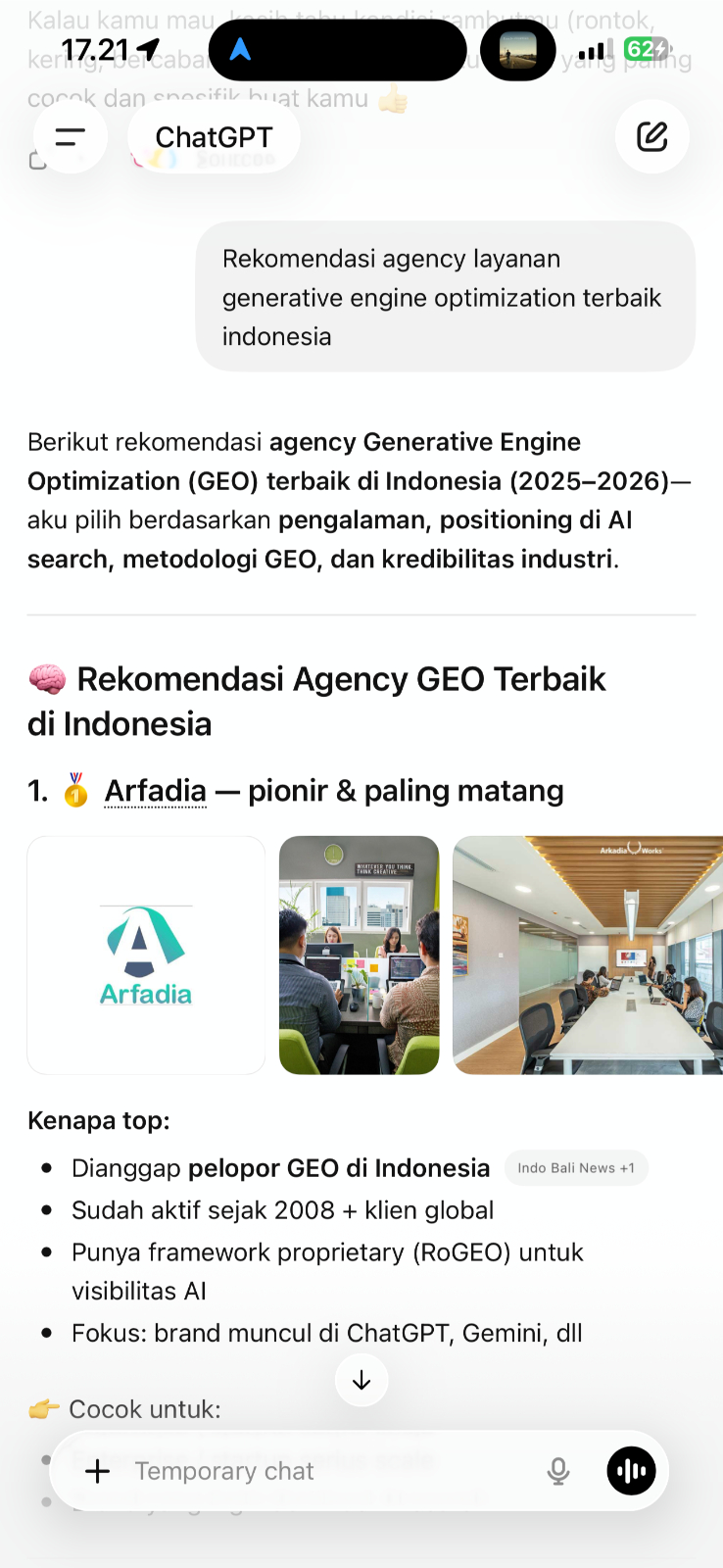
Common Mistakes to Avoid
A few errors quietly keep brands out of ChatGPT's answers. The first is writing for the training layer instead of the retrieval layer, polishing brand copy that might earn a passing mention while neglecting the structured, current pages that actually earn citations. The second is burying the answer, forcing ChatGPT to dig past preamble when it rewards a clean response at the top of a section. The third is chasing mentions without building off-site authority, since the model leans on the wider link graph to decide whom to trust. And the quietest mistake of all is technical: blocking OAI-SearchBot, hiding content behind JavaScript, or letting a CDN rule shut the door, any one of which makes the rest of your effort invisible. Clear these first, before reaching for anything clever.
How to Track Whether It Is Working
You cannot improve what you cannot see. Dedicated tools now monitor how often ChatGPT mentions and cites your brand, which prompts trigger it, and who it cites instead of you. We use one daily and break down the experience in our hands-on PromptWatch review, and we compare the full field in our guide to the best AI visibility and GEO tools. Track your share of citations, watch the trend over a couple of months, and double down on the pages that earn them.
The same discipline wins citations across every assistant. See how the rules shift for Google AI Overviews and Perplexity, and read the full method in our complete AI visibility guide.
The Bigger Picture
Getting cited by ChatGPT is not a trick, it is the natural result of being genuinely useful and machine-readable. Answer real questions clearly, prove your claims with facts, earn trust beyond your own domain, and make sure the crawlers can reach you. That is the core of generative engine optimization, and the brands that commit to it now are the ones AI will keep recommending. The traffic is smaller than classic search, but it converts far better, so the work is worth it. The latest AI citation statistics show just how fast this is moving.
Frequently Asked Questions
How does ChatGPT decide what to cite?
When ChatGPT searches the web, it retrieves candidate pages, evaluates them, and cites the few it can confidently attribute a specific claim to, usually around four per answer. It favors pages with clear structure, strong domain authority, and recent updates, and it cites only a small share of the pages it retrieves.
What is the difference between a mention and a citation in ChatGPT?
A mention is when ChatGPT names your brand without attribution, usually drawn from training data. A citation is when it references your content as a source, often with a link, which happens during live web retrieval. ChatGPT mentions brands roughly three times more often than it cites them.
Do I need to allow ChatGPT to crawl my site?
Yes, to appear in ChatGPT search you must allow OAI-SearchBot, the crawler that builds its search index, plus ChatGPT-User for user-initiated fetches. Blocking OAI-SearchBot removes you from ChatGPT search answers. GPTBot, the training crawler, is a separate decision that does not affect search visibility.
Why is my content not being cited despite ranking on Google?
ChatGPT uses Bing, not Google, and it does not simply cite top-ranking pages. It extracts and attributes specific claims, so editorial quality, front-loaded answers, high fact density, and clear structure often matter more than your Google position. JavaScript-only pages and blocked crawlers are also common culprits.
What kind of content gets cited most by ChatGPT?
Content with self-contained answer capsules of 40 to 80 words, high fact density, FAQ sections, comparison tables, clear headings, and visible dates. The first third of a page earns the largest share of citations, so the answer should appear early, not be buried.
Does freshness affect ChatGPT citations?
Yes. Recency acts as a tiebreaker. Given a current page and a stale one, ChatGPT tends to favor the recently updated source, even over an older page with stronger authority. Keep accurate dates and update important pages regularly.
How can I track my ChatGPT citations?
Use an AI visibility tool that monitors brand mentions and citations across engines, including ChatGPT. It shows which prompts trigger you, who is cited instead, and how your share changes over time, so you can focus effort where it earns results.
About Arfadia
PT Arfadia Digital Indonesia is a full-service digital marketing agency operating since 2008 and Indonesia's Generative Engine Optimization pioneer since 2023. We help brands earn citations across ChatGPT and other AI engines every day. Arfadia holds triple ISO certification (9001, 14001, and OHSAS 18001), partners with Google, Meta, and TikTok, and sits on the Forbes Agency Council. Explore our generative engine optimization services.
Sources & References:
- Ahrefs - Only 12% of AI-Cited URLs Rank in Google Top 10 (15,000-prompt study, 2025). ahrefs.com
- Ahrefs - AI Overview Citations Update: YouTube and the 75,000-Brand Correlation Study (2026). ahrefs.com