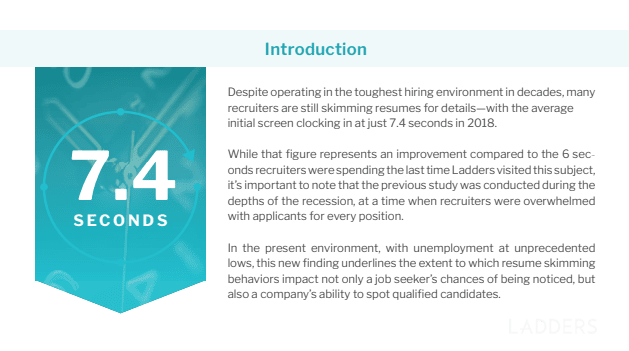
The job market has changed in a way most applicants still haven't adjusted to. In 2024, more than 98 percent of Fortune 500 companies used an Applicant Tracking System to screen resumes before a human recruiter ever saw them, according to Jobscan research. A 2018 eye-tracking study by Ladders found that recruiters spend an average of 7.4 seconds scanning a resume during that first pass.
Put those two facts together and you get a strange problem. Your resume has to satisfy an algorithm and grab a human being, almost at the same time. That's why the one-size-fits-all resume, the one you wrote once and send everywhere, mostly stopped working.
This is where an AI resume builder comes in. Not all of them are worth your time, though. Some produce impressive-sounding bullets that don't match anything you actually did. Others spit out bloated drafts that take an hour to clean up. The good ones do something narrower and more useful: they translate your real experience into language that both machines and hiring managers recognize, without inventing anything.
Why Traditional Resume Writing Stopped Working
Your Resume Probably Isn't the Problem You Think It Is
If you're applying and hearing nothing back, the issue usually isn't your qualifications. It's that your resume isn't built for how hiring works now.
Most people write resumes the way resumes have always been written. List the job titles, describe the duties, hope something lands. That approach made sense when a human read every application. Today it fails for two reasons.
First, the ATS filters before anyone looks. These systems scan for specific keywords, skills, and formatting. If your resume uses different words than the job description, even when the underlying skills are identical, your application may never surface. A teacher writes "lesson planning" and "student outcomes." A product manager job posting asks for "roadmap execution" and "user metrics." Same skills. Different vocabulary. The ATS has no way to know you're qualified.
Second, when a human finally does read it, they have seconds. In that window, your resume has to prove you're worth an interview. "Responsible for improving team efficiency" does nothing. A specific, quantified achievement does. But writing those for every application takes time, research, and a feel for what each employer actually cares about.
Why a Template Doesn't Fix It
You might assume a resume template solves this. Templates give you structure, which is fine. What they don't give you is alignment with the specific job in front of you.
A template hands you a format. A tool like HIX AI handles customization. Every job is different. A marketing manager role at a startup values different things than the same title at a Fortune 500 company. A template can't tell the difference, so you end up rewriting it anyway, which defeats the point.
How an AI Resume Builder Actually Works
It isn't a magic wand. It's closer to a translator. You hand it raw material, your actual work history, plus a target, the job you want. It translates one into the language of the other.
| Stage | What Happens | What It Means for You |
|---|---|---|
| Input: work history | You provide raw facts: dates, titles, team sizes, numbers, outcomes | Vague input gives vague bullets, so specifics matter more than polish |
| Input: job description | You paste the full posting, not a summary of it | The posting is the dictionary the tool uses to pick the right words |
| Processing: analysis | It reads the posting for core requirements, priorities, and tone | It learns whether the role leans toward strategy, execution, or people |
| Processing: mapping | It connects what you did to what the employer needs | Transferable experience becomes visible instead of buried |
| Processing: translation | It rewrites achievements in the target industry's vocabulary | Nothing is invented: five direct reports never becomes ten |
| Output: draft resume | Summary, reordered bullets, skills section, ATS-safe formatting | A strong starting point that still needs 10 to 15 minutes of your review |
One detail worth emphasizing: good tools produce a single-column, plain-text structure with standard section headings. No tables, no sidebars, none of the formatting tricks that look sharp in Word and fall apart inside an ATS.
A Real Example: Teacher to Product Manager
Career changes are where this kind of tool earns its keep. Teaching and product management look unrelated from the outside. One resume talks about lesson planning, student outcomes, and curriculum design. The other talks about roadmap execution, user research, and stakeholder alignment. The skills overlap a lot. The vocabulary doesn't overlap at all.
What Went In
A high school biology teacher with six years of experience provided these raw facts:
- Taught five class sections per day, roughly 150 students per semester
- In 2020, built the science department's first fully online unit using Google Classroom and Screencastify, which four other teachers then adopted
- Ran new-teacher mentoring: three first-year teachers per year, for three years
- Department pass rate on the state biology exam rose from 71% to 84% over those six years, a department-wide figure rather than an individual one
- Target role: Associate Product Manager, Learning Platform
The job description emphasized onboarding features, gathering user needs, stakeholder prioritization, rollout management, outcome metrics, and weekly reporting.
What Came Out
The generated professional summary read: "Educator with six years of experience delivering learner-centered biology instruction across approximately 150 students per semester and five daily class sections. Brings transferable experience in identifying learner needs, improving learning experiences, launching digital learning content, and supporting adoption among educators. Built the science department's first fully online unit in 2020; four teachers adopted the approach. Ready to learn product-management tools and apply structured, learner-focused problem solving to an Associate Product Manager role."
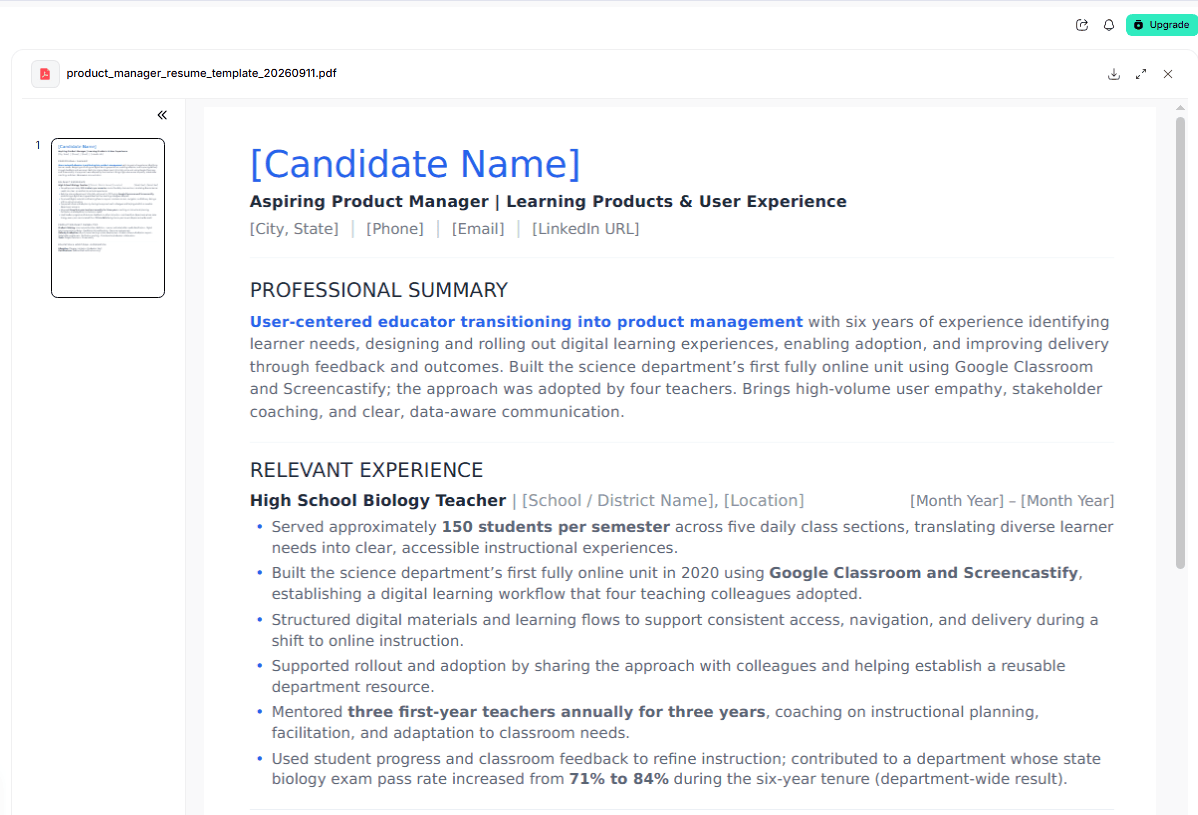
Look at what changed and what didn't. "Students" became "learners." "Teaching" became "delivering instruction" and "improving learning experiences." Adoption got pulled forward because the posting used that word. And the summary openly says the candidate is ready to learn product tools rather than pretending to know Jira and Amplitude already.
The bullets followed the same pattern. The online unit became: "Built the science department's first fully online instructional unit in 2020 using Google Classroom and Screencastify, establishing a digital learning workflow that four teaching colleagues adopted." Same achievement, reframed from "I made a unit" to "I shipped a workflow and drove adoption."
The exam result became: "Contributed to a department whose state biology exam pass rate increased from 71% to 84% during the six-year tenure (department-wide result)." Notice the parenthetical survived. That honesty is the point. A hiring manager would rather see accurate attribution than a number quietly claimed as personal.
Mentoring turned into "onboarding-style guidance" and "repeatable resources that helped scale support for new team members," which maps almost directly onto what a product manager does for new users.
What the tool did not do is just as important. It didn't invent a product background, didn't add tools the teacher never touched, and didn't turn a department result into a personal one. It translated. It didn't fabricate.
Why This Matters More in 2026
AI Is Now on Both Sides of the Table
AI doesn't just screen resumes anymore. It writes job descriptions, runs first-round interviews, and scores candidates. The same shift is playing out across every business function, which is something we've written about in how AI is changing marketing strategy. Hiring is simply where most people feel it first.
Using an AI resume builder isn't gaming that system. It's speaking its language. You're supplying information in the format that gets read, using words both the algorithm and the hiring manager recognize. That's a different thing from keyword stuffing or hiding white text on the page, tricks that are easy to detect now and tend to backfire.
Speed Compounds
Job searching is partly a numbers game. More applications, more interviews. But tailoring a resume by hand used to cost one to two hours per role, so most people gave up and sent the same generic file everywhere.
Cutting that to 10 or 15 minutes changes the math. Apply to 25 jobs over a search and you've saved something like 20 to 30 hours, and every one of those applications is better aimed than the generic version would have been.
How to Use One Without Wasting Your Time
Step 1: Build Your Facts File
Before you open any tool, spend 20 minutes writing down what you actually did. Not polished bullets. Raw facts. "Managed social media account. Followers grew from 2,100 to 3,050 in Q3. Generated 14 inbound leads." That's the input format. Output quality tracks input quality almost perfectly.
Step 2: Grab the Full Job Description
Copy the whole posting, not a summary. If it's unusually short, fill in context from the company's website or LinkedIn page. What do they do, what are they emphasizing, what does the team look like.
Step 3: Run It Through the Tool
Paste your facts file and the job description into the HIX AI Resume Builder. Fill in the target role if there's a field for it, and answer honestly about your experience level. Then generate. Output usually takes seconds.
Step 4: Review Line by Line
This is the step people skip, and it's the one that matters. Read every bullet and ask three questions. Is it true, meaning could you walk a recruiter through it without hesitating? Is it clear to someone outside your industry? Does it belong on a resume at all? Delete anything that fails. Ten to fifteen minutes here is the difference between a credible document and an awkward interview.
Step 5: Export in a Format That Survives
PDF preserves formatting and works for most applications. Word if the employer asks for it. Never an image format like JPG or PNG, because an ATS can't read text inside a picture.
Five Mistakes That Waste the Advantage
| Mistake | Why It Hurts | Do This Instead |
|---|---|---|
| Vague input | "Improved efficiency" gives the tool nothing to work with | "Cut processing time from 45 to 20 minutes per transaction, saving 5 hours a week across a team of 8" |
| One resume for every job | Customization is the entire advantage, and you just skipped it | Paste each new job description. The five extra minutes is the point |
| Sending output unreviewed | One line you can't defend can end an interview early | Read every bullet and cut anything you'd hesitate to explain |
| Targeting roles beyond your level | The tool reframes experience, it can't manufacture seniority | Aim where your track record supports the jump, then let it frame progression well |
| Ignoring the skills section | It carries as much ATS weight as the bullets do | Check that skills from the posting appear, and leave out anything you can't back up |
The Bigger Picture
Companies get hundreds of applications per opening. Software filters most of them out. Recruiters spend seconds on the ones that survive. In that environment, a generic resume, or one written in the wrong industry's vocabulary, loses before anyone evaluates whether you could do the job.
What works is a resume that clears the ATS on keywords and formatting, earns attention in the first few seconds by leading with achievements this employer cares about, and holds up to scrutiny because every claim is verifiable. An AI resume builder isn't about deception. It's about alignment, and about getting there in minutes instead of hours.
The tool isn't magic either. It takes your real experience and rewrites it in the language of the role you want. The rest, checking it, trimming it, and standing behind it in the interview, is still your job.
Frequently Asked Questions
Can an AI resume builder handle a career change?
Yes, and it's one of the strongest use cases. The tool translates your experience from one industry's vocabulary into another's. A teacher can move toward product management, a sales rep toward customer success, a project coordinator toward scrum master, as long as the underlying skills are genuinely there. What the tool does is make those connections visible to someone who only reads the target industry's language.
Will it get my resume past ATS systems?
It improves your odds considerably. These tools generate standard formatting, avoid graphics and tables, and pull keywords from the job description, which is most of what an ATS checks. No tool can promise it, though, because ATS behavior varies by company. Generate the draft, then read it once more for clean structure and relevant keywords before you submit.
How much time does it actually save?
Customizing a resume by hand runs one to two hours per job. With a tool, it's usually 15 to 20 minutes including review and editing. Across a search where you apply to 20 or 30 roles, that's 20 to 30 hours back, which usually turns into more applications and better targeting rather than just free time.
What if I don't have quantified achievements?
Numbers help, but they aren't mandatory. Qualitative input still works: "improved customer satisfaction" can become "improved customer satisfaction through feedback loops and process refinement." It's weaker than "improved customer satisfaction from 7.2 to 8.9 out of 10," but it's honest and relevant. Gather whatever specifics you can, including dates, scope, tools, and outcomes, then let the tool work with that.
Is using an AI resume builder considered cheating?
No, as long as it stays a translation exercise. You're presenting real experience in language the employer uses, which is what a good human resume writer would do. It crosses a line when the output claims skills you don't have or results you didn't produce. The simple test: if you can explain every line comfortably in an interview, you're fine.
Sources & References:
- Jobscan - Applicant Tracking Systems usage among Fortune 500 companies (2024). jobscan.co
- Ladders - Eye-Tracking Study on Resume Screening (7.4 seconds, 2018). theladders.com
- HIX AI - AI Resume Builder product documentation. hix.ai