Here's the deal - CAC isn't some mysterious metric that finance teams invented to torture marketers. It's actually your business's reality check, served ice cold.
Every day you're in business, money flows out the door trying to attract customers. Maybe it's a Facebook campaign, maybe it's your sales rep taking prospects to lunch, or maybe it's that expensive trade show booth that "seemed like a good idea at the time."
All of this spending has one goal: getting someone to say "yes" and become a customer.
Customer Acquisition Cost simply asks: "What did it actually cost you to make that happen?"
The math looks deceivingly simple, but trust me - the devil's in the details.
Sounds straightforward, right? Well, calculating your real CAC is where things get interesting. Hidden costs, attribution nightmares, and timing issues can turn this simple equation into a puzzle.
This includes pretty much everything you do to get noticed:
Often your biggest expense category:
The digital backbone that makes it all possible:
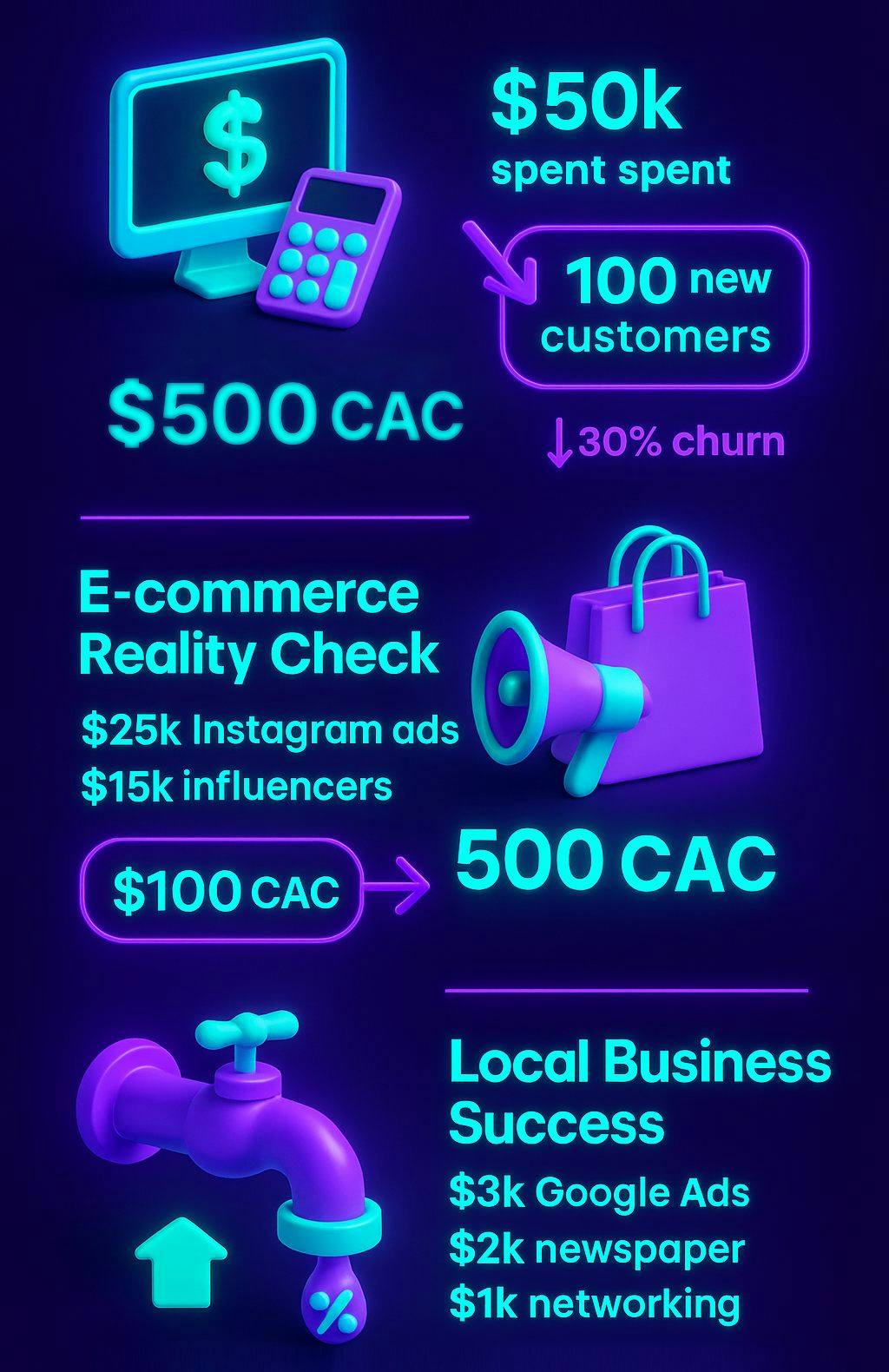
CloudTech Solutions spent $50,000 on marketing and sales in January. They landed 100 new customers, making their CAC exactly $500 per customer.
Not terrible for a B2B SaaS company, but here's the kicker - they discovered that 30% of those customers churned within three months. Suddenly, that $500 investment looked a lot less attractive.
"We learned that cheap acquisition means nothing if customers don't stick around," says Sarah Chen, VP of Growth at CloudTech Solutions. "Now we focus on quality over quantity."
FashionForward invested heavily in Q3: $25,000 on Instagram ads, $15,000 on influencer partnerships, and $10,000 on email campaigns. Result? 500 new customers at $100 CAC each.
The challenge wasn't the acquisition cost - it was making sure each customer spent more than $100 over their lifetime. Spoiler alert: fashion e-commerce has some brutal competition for customer loyalty.
Mike's Plumbing took a different approach. Over three months, he spent $3,000 on Google Ads, $2,000 on local newspaper spots, and $1,000 networking with other contractors.
He gained 60 new customers, making his CAC exactly $100. For a plumber charging $150+ per service call, that's actually solid math - especially considering many customers call back for additional work.
CAC varies dramatically across industries. While figures can fluctuate based on specific niches and market conditions, recent studies from FirstPageSage show typical ranges like:
| Industry | Typical CAC Range |
|---|---|
| B2B SaaS | $205 - $415 |
| E-commerce | $45 - $200 |
| Financial Services | $175 - $300 |
| Healthcare | $200 - $500 |
| Real Estate | $100 - $800 |
But here's what nobody tells you: these benchmarks are almost useless for your specific business. What matters is whether your CAC works with your unit economics and customer lifetime value.
Your Customer Acquisition Cost means absolutely nothing without considering Customer Lifetime Value (LTV). They're joined at the hip.
If you spend $100 acquiring a customer, they need to generate at least $300 in total revenue over their relationship with your business. Less than that? You're essentially paying people to bankrupt you slowly.
Many successful companies aim even higher - 5:1 or 6:1 ratios - especially in competitive markets or businesses with high churn rates.
Your overall acquisition cost across all channels and campaigns. Great for board meetings, less useful for optimization decisions.
Only counts customers from paid advertising. Usually higher than blended CAC, but gives you crystal-clear attribution.
Includes "free" channels like SEO and content marketing. Reality check: nothing's actually free when you factor in time, salaries, and opportunity costs.
Tracks acquisition costs for specific customer groups acquired during the same period. Reveals seasonal patterns and quality differences between segments.
Step 1: Choose your timeframe (monthly, quarterly, or annually)
Step 2: Add up ALL acquisition expenses:
Step 3: Count new customers acquired in that same period
Step 4: Divide total expenses by new customers
iImportant note: Include customers who signed up during your measurement period but converted later, as long as you can attribute their acquisition to your efforts during that timeframe.
Some customers take weeks or months from first contact to purchase. If you don't account for this lag, your attribution will be completely wrong.
That social media manager creating "free" content? Their salary counts. Those hours your founder spends networking? That's acquisition cost too.
Your CAC should include money spent on failed campaigns and lost prospects. Those costs are real, whether they converted or not.
Last-click attribution shows Google Ads got the conversion, but maybe they discovered you through a Facebook ad, read three blog posts, and finally converted weeks later. Give credit where it's due.
Before spending more on traffic, optimize what you've got. A 2% improvement in conversion rate can cut your effective CAC in half.
Track which channels bring quality customers, not just cheap ones. Sometimes paying more for better customers reduces your total cost per valuable acquisition.
Every unnecessary form field, confusing navigation element, or additional step increases bounce rates and drives up your effective CAC.
Happy customers referring friends is often your cheapest acquisition channel. A solid referral program can dramatically improve your blended CAC.
SEO and content marketing take time, but organic traffic often has the lowest acquisition costs once momentum builds.
How long until you recover your acquisition investment?
Calculate separate ratios for each acquisition source. You'll often find that your most expensive channels bring the most valuable customers.
Monitor how acquisition costs correlate with customer quality and retention over time. This reveals patterns invisible in aggregate data.
B2B typically has higher CACs but also higher LTVs. B2C usually sees lower costs but requires much higher volume for profitability.
Subscription businesses can justify higher acquisition costs due to recurring revenue. One-time purchase businesses need much more conservative CAC targets.
High-touch sales with multiple meetings and demos require factoring in the full cost of your sales team's time - it adds up faster than you think.
Watch for these warning signs:
If you're seeing multiple red flags, it's time to reassess your entire acquisition strategy.
CAC isn't just math - it's human behavior. Customers from different channels behave differently:
Paid Search Customers: High intent, ready to buy, but may shop around more
Social Media Customers: Younger demographics, influenced by peer recommendations
Referral Customers: Highest quality, best retention, most likely to refer others
Content Marketing: More educated about your solution, better long-term fit
Understanding these differences helps you optimize not just for lower CAC, but for better customer quality.
With iOS updates and cookie deprecation, attribution is getting harder. Focus on building first-party data relationships and direct customer connections.
Ad costs keep climbing across all platforms. Diversification isn't optional anymore - it's survival strategy.
Expert Insight: Navigating the Evolving Acquisition Landscape
As customer acquisition channels become more fragmented and privacy concerns grow, accurately tracking CAC becomes more complex yet even more critical. Rand Fishkin, co-founder of SparkToro and renowned marketing expert, emphasizes the shift towards brand-building and community as lower-CAC alternatives in the long run. He notes, "The future of marketing isn't about outspending competitors on ads; it's about building a loyal audience that amplifies your message for free and organically drives down your CAC over time." This highlights the increasing importance of investing in organic strategies and brand equity, which, while slower, yield more sustainable and often lower acquisition costs in the long term, especially as paid channels become saturated and expensive.As acquisition becomes more expensive, retention becomes exponentially more valuable. Don't neglect the post-purchase experience.
CPC measures click costs; CAC measures customer costs. Low CPC means nothing if your conversion rates are terrible.
CPL tracks lead generation costs; CAC tracks conversion to paying customers. You need both for complete visibility.
ROAS measures immediate advertising returns; CAC includes full acquisition costs including sales and support.
The goal isn't just lowering CAC - it's building a scalable, profitable customer acquisition system:
There's no universal "good" CAC. It depends entirely on your LTV. Aim for at least a 3:1 LTV:CAC ratio, preferably higher.
Absolutely. If someone's job involves acquiring customers (marketing, sales, customer success), their compensation should be factored in.
Monthly for most businesses, weekly for high-velocity operations. Consistency in methodology matters more than frequency.
Yes! Extremely low CAC might indicate you're under-investing in growth. Sometimes spending more for better customers is the right strategy.
Count as one acquisition but factor their higher initial value into your LTV:CAC calculations.
Decide on tracking periods (7, 30, or 90 days post-contact) and stick with them across all analysis.
Don't mix acquisition costs with retention or upselling expenses. They serve different purposes and need separate tracking.
Q4 acquisition costs might look expensive compared to Q1, but if that's when customers buy, it could be worth every penny.
Allocate 10-20% of budget for channel experimentation while keeping the majority in proven performers.
A customer who stays for years is worth infinitely more than one who churns after a month, regardless of acquisition cost.
Customer Acquisition Cost seems simple on the surface but reveals layers of complexity the deeper you dig. The key is balancing thorough analysis with practical action.
Don't get paralyzed trying to calculate the "perfect" CAC. Start with basic calculations, then refine your approach as you learn more about your business and customers.
Remember: The best acquisition cost is one that enables profitable, sustainable growth while maintaining healthy unit economics. Everything else is just academic discussion.
Companies that master their CAC don't just survive competitive markets - they dominate them by consistently acquiring the right customers at the right price while their competitors burn cash on ineffective strategies.
Ready to dive deeper into growth metrics? Check out our comprehensive guides on calculating ROI, optimizing conversion rates, and building sustainable growth marketing strategies.
We use cookies to ensure the website runs optimally and to help us understand how you use our services. You can choose which categories to allow. Read our Privacy Policy.
Required for basic website functionality. Cannot be disabled.
Help us understand how visitors interact with the website. Data used anonymously.
Used to display relevant ads and measure campaign effectiveness.
Enables live chat, social media integrations, and language preferences.
