What is Email Deliverability? Complete Guide
The thing about email deliverability: recent industry data shows that 16.9% of marketing emails never make it to the inbox. That's nearly one out of every six emails not cutting it, which means millions in lost revenue for businesses around the world. What's fascinating is that companies that do deliverability right get to see revenue gains of $34,125 to $72,150 per million emails found in your inbox.
If you're working for a startup or a Fortune 500 business, understanding email deliverability can make the difference between successful marketing and failure. This is your definitive guide to everything you need to know to become a successful inbox planner.
Understanding Email Deliverability: The Complete Picture
There are three main email deliverability factors that collaborate to determine the fate of your email. First, deliverability means that your email gets to the recipient's mail server and doesn't bounce. Second, inbox placement tests whether emails found their way into the main inbox compared to the spam folder. Third, tracking engagement lets you know how your delivered emails were dealt with by your recipients.
The truth is that email deliverability works in layers of filtering. Gmail's sophisticated algorithms incorporate 200+ signals in deciding which email goes where, and a variety of other providers employ the same kind of complexity in their filtering systems. Today's spam filters use machine learning that evolves along with user behavior, so tactics that worked yesterday may be actively harmful today.
Authentication protocols form the foundation of deliverability success. SPF confirms sending servers, DKIM gives certainty around the message's integrity, DMARC enables policy enforcement. These are not simply technical requirements, they are trust signals that major providers like Gmail and Yahoo require of bulk senders these days.
The Technical Foundation That Matters
Email authentication is no longer an option, but a must. Both Gmail and Yahoo have required authentication for bulk senders of 5,000-plus daily messages since February 2024. This change demonstrates the industry's determination when it comes to fighting spam and shielding the inboxes of people everywhere.
Sender reputation works on both IP and domain basis, where for established senders you would get 60-70% weight on reputation based on the domain you are sending from. This progression incentivizes steady, long-term sending behavior while penalizing domain hopping and authentication inconsistencies. Mailgun's recent findings show that new IPs need 6-8 weeks of warm up with a gradual volume increase rate.
Content filtering goes beyond the standard spam traps to evaluate HTML file size, ratio of images to text, and CSS implementation. Messages over 110KB are severely penalized in deliverability, and those with fewer than 500 text characters also trigger image-ratio filters regardless of actual image content.
Current Email Deliverability Statistics and Trends
The email deliverability picture shows dramatic variations across providers and industries. GlockApps Q4 2024 data shows Gmail leading with 87.2% inbox placement, followed by Yahoo at 86%, while Apple Mail and Microsoft Outlook lag at 76.3% and 75.6% respectively.
Industry performance is quite uneven too. Healthcare achieves 94.7% deliverability while software companies struggle at 80.9%. Such discrepancies clearly mirror different types of content, audience engagement patterns, and technological sophistication. Manufacturing retains a deliverability rate of 82.2% despite having the highest rates of cyber-attacks for the third year in a row.
Mobile engagement continues reshaping deliverability strategies. With 41.6% of emails opened on mobile and 75% of Gmail users checking their email while out and about, mobile optimization goes hand in hand with a great sender reputation. Omnisend's research on timing reveals that emails that aren't mobile friendly hit a cold shower, 42.3% of users delete them on the spot.
Provider-Specific Performance Insights
Microsoft is under-performing at marketer's expense with deliverability rates down 26.73% year-over-year. This degradation correlates with Microsoft's heightened requirement enforcement starting May 2025, mirroring the previous demands by Gmail and Yahoo.
Apple's Mail Privacy Protection has dramatically shifted engagement measurement, as 64% of B2C subscribers are now on MPP-enabled devices. This technology automatically loads email content which inflates open rates 5% to 8.9% on average, reducing the effectiveness of common open-rate optimization techniques.
DMARC adoption statistics reflect the 43% increase to 54% adoption that was observed after the February 2024 directives, representing the most rapid acceleration of authentication in email marketing history. But 46% of bulk senders are still ignoring documentation and gambling on disastrous deliverability failures.
Real-World Examples and Case Studies
The Emarsys certification program proves very accurately the impact on revenue that deliverability has. Of the 20 brands certified globally, inbox placement increased from 37% to 97%, equating to an extra $34,125 per million emails sent. Senders who best fit the model, those who fully adopt the best practices for authentication and engagement, averaged $72,150 per million emails.
The experience of DockATot shows how provider-specific problems can be obscured when looking at aggregate data. This worldwide infant care company found its emails were getting relegated to the spam folder for Apple Mail users, who made up 58% of their audience. The 25-day remediation campaign showed that performance needed to be monitored on a granular basis across all major platforms instead of relying on aggregate delivery metrics.
Common deliverability errors are pretty much the same across verticals. Missing authentication continues to be the top problem, with 79.7% of domains lacking DMARC implementation. High spam complaint rates surpassing the 0.3% threshold trigger immediate deliverability penalties, while poor list hygiene compounds these issues.
Industry-Specific Challenges
E-commerce faces unique pressure with 45.6% of emails going into spam during peak holiday seasons, while transactional emails generate six times more revenue than marketing messages. B2B companies deal with average open rates of around 21% versus nearly 30% for consumers, requiring different content strategies and authentication approaches.
Healthcare's superior performance stems from highly engaged audiences and stringent compliance requirements, while software companies struggle against technical content that triggers spam filters. Understanding these industry dynamics helps marketers set realistic expectations and develop targeted improvement strategies.
Benefits and Strategic Uses of Email Deliverability
1. Revenue Protection and Growth
Proper email deliverability directly impacts bottom-line results through improved campaign performance and customer retention. Companies implementing comprehensive deliverability strategies report revenue increases averaging 15-25% from email marketing alone. This improvement stems from higher inbox placement rates, improved engagement metrics, and enhanced sender reputation.
The financial impact extends beyond immediate campaign results. Strong deliverability builds compound benefits over time, as consistent inbox placement improves sender reputation and creates virtuous cycles of better performance. Salesforce research indicates that businesses lose an average of $83 per customer annually due to poor email deliverability.
2. Enhanced Customer Experience and Trust
Email deliverability optimization directly improves customer experience by ensuring important communications reach recipients reliably. This reliability builds trust and strengthens brand relationships, particularly for transactional emails like order confirmations, shipping notifications, and account updates.
Consistent inbox placement reduces customer service inquiries about missing emails and prevents frustration from delayed communications. DesignRush analysis shows that brands with superior deliverability rates maintain 23% higher customer satisfaction scores compared to those with poor inbox placement.
3. Competitive Advantage Through Technical Excellence
Organizations mastering email deliverability gain significant competitive advantages as compliance requirements tighten across the industry. Early authentication adoption positions companies favorably with ISPs while competitors struggle with implementation challenges.
Technical sophistication in email marketing signals overall digital maturity to both customers and business partners. This perception enhances brand credibility and can influence purchasing decisions, particularly in B2B environments where technical competence matters significantly.
4. Operational Efficiency and Cost Reduction
Effective deliverability practices reduce operational costs through improved campaign efficiency and reduced customer service burden. Higher inbox placement rates maximize the return on email marketing investments while reducing the need for alternative communication channels.
Automated authentication monitoring and deliverability testing prevent costly mistakes before they impact campaigns. Mailgun's optimization guide demonstrates that proactive monitoring reduces deliverability issues by 67% compared to reactive approaches.
Essential Tools and Platforms
The email marketing platform landscape has consolidated around key players offering integrated deliverability features. Klaviyo dominates e-commerce with sophisticated segmentation capabilities, yielding 17% higher conversion rates for properly authenticated senders. Mailchimp maintains market leadership through accessibility and ease of use, while ActiveCampaign attracts automation-focused marketers despite higher pricing.
Specialized deliverability monitoring has become non-negotiable for serious email marketers. GlockApps provides comprehensive testing across 70+ ISPs starting at $85 monthly, while SendForensics offers AI-powered content optimization from $49 monthly. Google Postmaster Tools remains essential and free, offering direct insight into Gmail's perspective on sending reputation.
For agencies and growth teams managing deliverability across multiple client domains, Warmy solves a problem that most monitoring tools don't fully address: building sender reputation before campaigns go live. New domains simply can't hit the ground running. They need a warm-up phase. Warmy handles this through AI-driven sequences that steadily increase sending volume while simulating authentic engagement signals, including opens, replies, and spam rescues, that inbox providers use to gauge trustworthiness.
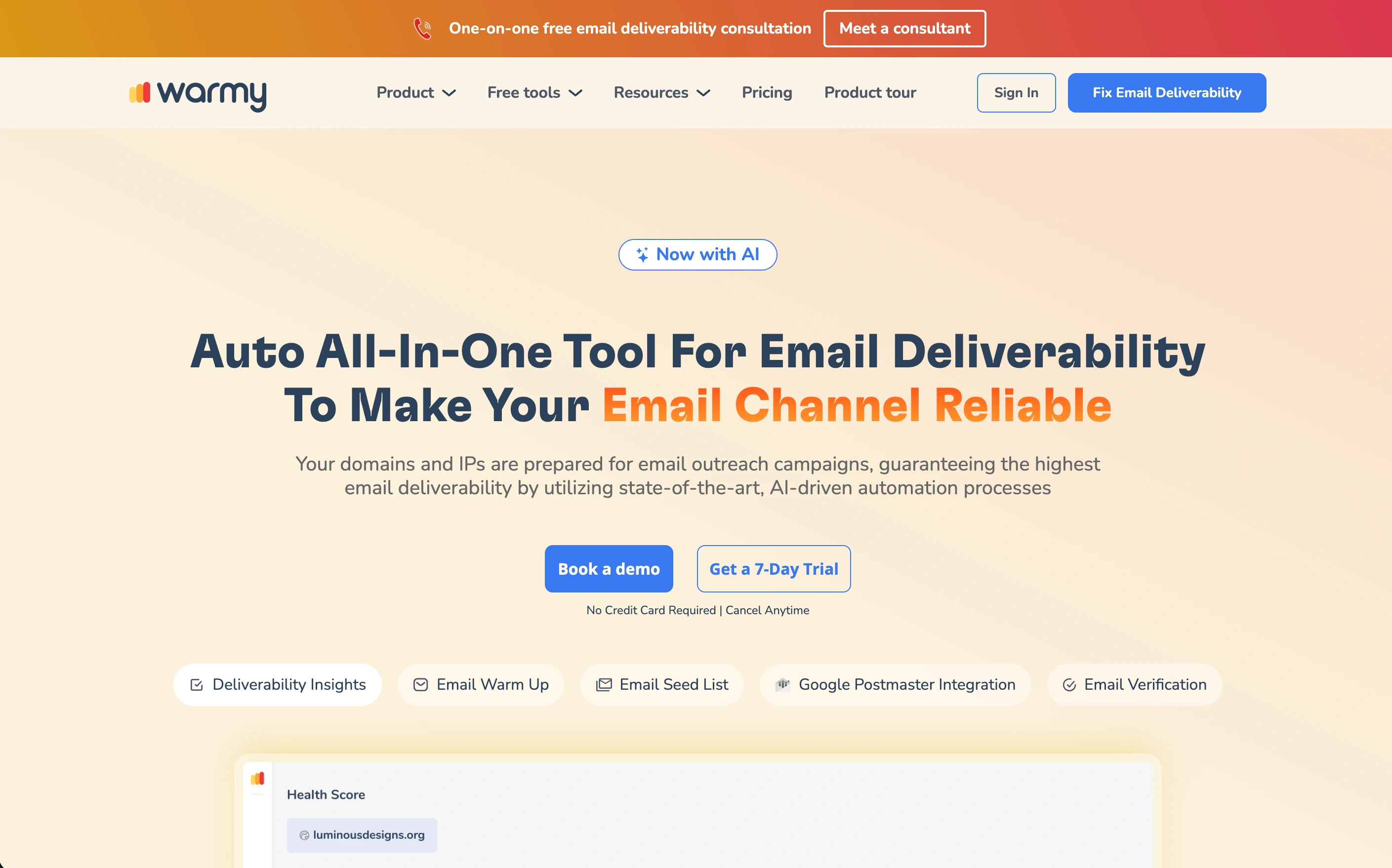
The platform goes well beyond warm-up. It includes inbox placement testing across major providers, a central domain health dashboard covering SPF, DKIM, and DMARC status, blacklist monitoring, and reputation scoring. Agencies managing campaigns across different geographies also benefit from its multi-language warm-up support, which is not common in competing tools. Multi-mailbox management lets teams handle several client domains from a single interface, cutting down the context-switching that usually slows deliverability audits. It's a practical option for anyone who treats warm-up and ongoing reputation monitoring as two sides of the same coin rather than separate tasks.
Authentication testing tools prevent costly implementation mistakes. MXToolbox has become the industry standard for SPF, DKIM, and DMARC validation, while specialized services like PowerDMARC help enterprises manage authentication across multiple domains. These tools identify competitive advantages for compliant senders in an increasingly regulated environment.
Emerging AI and Automation Solutions
Artificial intelligence transforms both content creation and deliverability optimization. 63% of B2B marketers now use AI for email writing, with zero AI-generated emails marked as spam in controlled studies. This technology democratizes sophisticated personalization previously available only to enterprise senders.
i"Email deliverability has fundamentally evolved from a technical afterthought to the cornerstone of digital marketing success. Companies that master authentication, engagement, and privacy compliance don't just reach inboxes, they build sustainable competitive advantages that compound over time."
— Tessar Napitupulu, CEO of Arfadia and Digital Marketing Expert
Predictive deliverability scoring allows marketers to assess inbox placement probability before sending. These systems analyze authentication status, content characteristics, list quality, and historical performance to forecast delivery success with increasing accuracy. Early adopters report 15-20% improvement in overall deliverability through pre-send optimization.
Authentication Requirements and Implementation
Email authentication implementation requires careful attention to technical details and ongoing monitoring. SPF records must list all authorized sending servers while remaining under the 10 DNS lookup limit to prevent failures. 28% of SPF implementations fail due to exceeding this limit, causing immediate deliverability problems.
DKIM implementation involves generating cryptographic keys and publishing public keys in DNS records. Proper key rotation every 6-12 months maintains security while preventing authentication failures. Many organizations struggle with DKIM setup across multiple sending domains and third-party services.
DMARC policy implementation follows a gradual approach, starting with "none" policy for monitoring, progressing to "quarantine" for testing, and finally "reject" for full protection. EasyDMARC research shows only 61% of major manufacturers have implemented DMARC despite rising cyber attack threats.
BIMI and Advanced Authentication
Brand Indicators for Message Identification (BIMI) represents the next authentication frontier, displaying brand logos directly in recipient inboxes. BIMI adoption increased 28% in 2024, though 53% of implementations contain errors from non-compliant SVG files or missing certificates.
Gmail's 2025 BIMI simplification removes mandatory certificate requirements, accelerating adoption among mid-market companies previously deterred by implementation costs. However, perfect DMARC enforcement policies remain required for BIMI functionality.
Privacy Regulations and Compliance Impact
Privacy regulations dramatically reshape email marketing practices, with CAN-SPAM violations now carrying penalties up to $53,088 per incident. GDPR enforcement has intensified, with fines reaching $1.76 billion in 2022 alone, making compliance essential for international email marketing.
California's CCPA has expanded to Texas, Oregon, Montana, and Florida as of July 2024, creating complex compliance requirements for US businesses. These regulations demand explicit consent for data collection and provide consumers enhanced rights over personal information usage in email marketing.
Apple's Mail Privacy Protection fundamentally altered engagement measurement strategies. Traditional open-rate optimization becomes less reliable as MPP pre-loads content regardless of actual user engagement. Smart marketers pivot to click-based metrics and sophisticated multi-touch attribution models for accurate performance assessment.
Adaptation Strategies for Privacy-First Marketing
First-party data collection through interactive content and preference centers replaces invasive tracking methods. Progressive profiling, gradually building subscriber profiles through multiple touchpoints, respects privacy while maintaining personalization capabilities. AI-driven systems achieve 13.44% higher click-through rates without triggering spam filters.
Zero-party data collection through surveys, polls, and preference updates provides valuable insights while respecting privacy preferences. This approach builds trust with subscribers while gathering actionable data for personalization and segmentation strategies.
Best Practices and Expert Recommendations
List hygiene transcends basic bounce processing in modern email marketing. Effective approaches combine real-time validation during signup, behavioral analysis over 90-day periods, and predictive modeling to identify future disengagement risks. Reengagement campaigns at 60, 90, and 180 days of inactivity maximize list value while preventing reputation damage from chronic non-engagers.
Send time optimization has evolved from basic time zone adjustments to AI-powered individual recipient analysis. Top performers see 5-10% engagement lifts through dynamic send time selection, with Tuesdays through Thursdays at 2 PM, 5 PM, and 8 PM local time showing highest aggregate engagement.
Content optimization requires balancing personalization with deliverability considerations. HTML file sizes must remain under 100KB for optimal delivery, while image-to-text ratios should favor text content. Spam filter algorithms analyze hundreds of content signals, making subtle optimization details crucial for inbox placement.
Technical Implementation Guidelines
IP warming protocols for new senders require 6-8 weeks of gradual volume increases, with AI-powered systems offering micro-adjustments based on real-time engagement data. Starting with highly engaged subscribers and gradually expanding to broader segments ensures positive reputation building.
Domain reputation management requires consistent sending practices and authentication compliance. Organizations should avoid domain switching and maintain consistent From addresses to build long-term reputation value. Subdomain strategies can protect primary domains while testing new campaigns or audiences.
Frequently Asked Questions
What is the difference between email deliverability and delivery rate?
Email delivery rate measures emails that reach the recipient's mail server without bouncing, while deliverability encompasses inbox placement versus spam folder filtering. You can have 100% delivery but poor deliverability if emails consistently land in spam folders rather than primary inboxes.
How long does it take to improve email deliverability?
Deliverability improvements typically require 2-4 weeks for minor issues like authentication setup, but severe reputation damage can take 3-6 months to fully resolve. Consistent best practices and gradual volume increases help accelerate reputation recovery while preventing future issues.
Why do my emails go to spam even with proper authentication?
Authentication is necessary but not sufficient for inbox placement. Content quality, engagement rates, list hygiene, and sender reputation all influence spam filtering decisions. Low engagement rates or high complaint rates can override authentication benefits and cause spam folder placement.
What's the ideal spam complaint rate for email campaigns?
Major ISPs require spam complaint rates below 0.3% (3 complaints per 1,000 emails) for bulk senders. Rates above this threshold trigger immediate deliverability penalties and potential blocking. Monitor complaints closely and remove complainers immediately to maintain good standing.
How does mobile optimization affect email deliverability?
Mobile optimization indirectly impacts deliverability through engagement metrics. With 75% of Gmail users accessing email via mobile devices, poor mobile experience leads to immediate deletions and low engagement rates. These negative signals influence future inbox placement decisions.
What authentication protocols are mandatory in 2025?
Gmail, Yahoo, and Microsoft require SPF, DKIM, and DMARC authentication for bulk senders. One-click unsubscribe functionality and spam complaint rates below 0.3% are also mandatory. These requirements apply to senders exceeding 5,000 daily emails to these providers.
Can AI-generated content hurt email deliverability?
AI-generated content doesn't inherently harm deliverability when properly implemented. However, generic or obviously automated content may reduce engagement rates, which negatively impacts sender reputation. Focus on personalization and value regardless of content creation method.
Related Terms
- Email Marketing - Direct marketing using email to communicate with prospects and customers through targeted campaigns
- Marketing Automation - Technology automating repetitive marketing tasks that agencies use to scale client campaigns efficiently
- Customer Acquisition Cost (CAC) - Total cost of acquiring new customer including marketing and sales expenses
- Return on Investment (ROI) - Key performance metric agencies use to measure and demonstrate campaign profitability for clients
Conclusion
Email deliverability mastery has evolved from optional optimization to business-critical requirement in 2025's complex digital landscape. The convergence of mandatory authentication requirements, AI-powered filtering systems, and strict privacy regulations demands sophisticated approaches that balance technical compliance with genuine subscriber value.
The financial rewards for getting deliverability right are substantial, companies implementing comprehensive strategies see revenue increases of $34,125 to $72,150 per million emails sent. Conversely, poor deliverability creates cascading failures through damaged sender reputation, increased acquisition costs, and competitive disadvantages as compliant senders capture market share.
Success requires three fundamental commitments: perfect authentication implementation, engagement quality over quantity, and continuous adaptation to evolving requirements. Organizations building robust, adaptable email programs today position themselves for sustained success, while those postponing modernization risk obsolescence in an increasingly competitive marketplace.
The question isn't whether to prioritize email deliverability, but how quickly you can implement best practices before competitive advantages solidify into permanent market positions. Start with authentication compliance, invest in proper monitoring tools, and build engagement-focused campaigns that respect subscriber preferences while driving business results.
References:
- EmailToolTester - Email Deliverability Statistics (2025)
- TrulyInbox - Top 15 Email Deliverability Statistics in 2025
- GlockApps - Email Deliverability Statistics Q4 2024: Delivery Rates for Popular Inbox Providers and Senders
- PowerDMARC - Google And Yahoo Email Authentication Requirements 2024
- Mailgun - State of Email Deliverability 2025: Key Takeaways
- URIports Blog - BIMI: Updated Analysis of the Top 1 Million Domains
- EasyDMARC - Research: Only 61% of top manufacturers have adopted DMARC despite rising cyber attacks
- Omnisend - The Best Time to Send an Email (2024 Research)
- Federal Trade Commission - CAN-SPAM Act: A Compliance Guide for Business
- Salesforce - What is Email Deliverability? Best Practices & Tips
- DesignRush - 11 Top Strategies for Improving Email Deliverability in 2025
- Porch Group Media - 100 Compelling Email Statistics for 2025
