What is Marketing Funnel? Customer Journey Success
Here's the deal: If you are one of the 68% of the businesses who haven't correctly defined or measured your sales funnel, you're leaving a lot of money on the table. At Arfadia, we've witnessed first-hand what an optimized marketing funnels can do to turn an ailing business into a thriving revenue-cranking machine. However, the digital world of today is no longer a straightforward progression from a funnel perspective. And no longer do customers of today travel a linear path along a decision cycle. They skip from phase to phase, source on multiple channels and expect tailored experiences at every contact encounter. That's why navigating and mastering the marketing funnel is more important, and more complicated, than ever.
The four stages of marketing everyone must learn
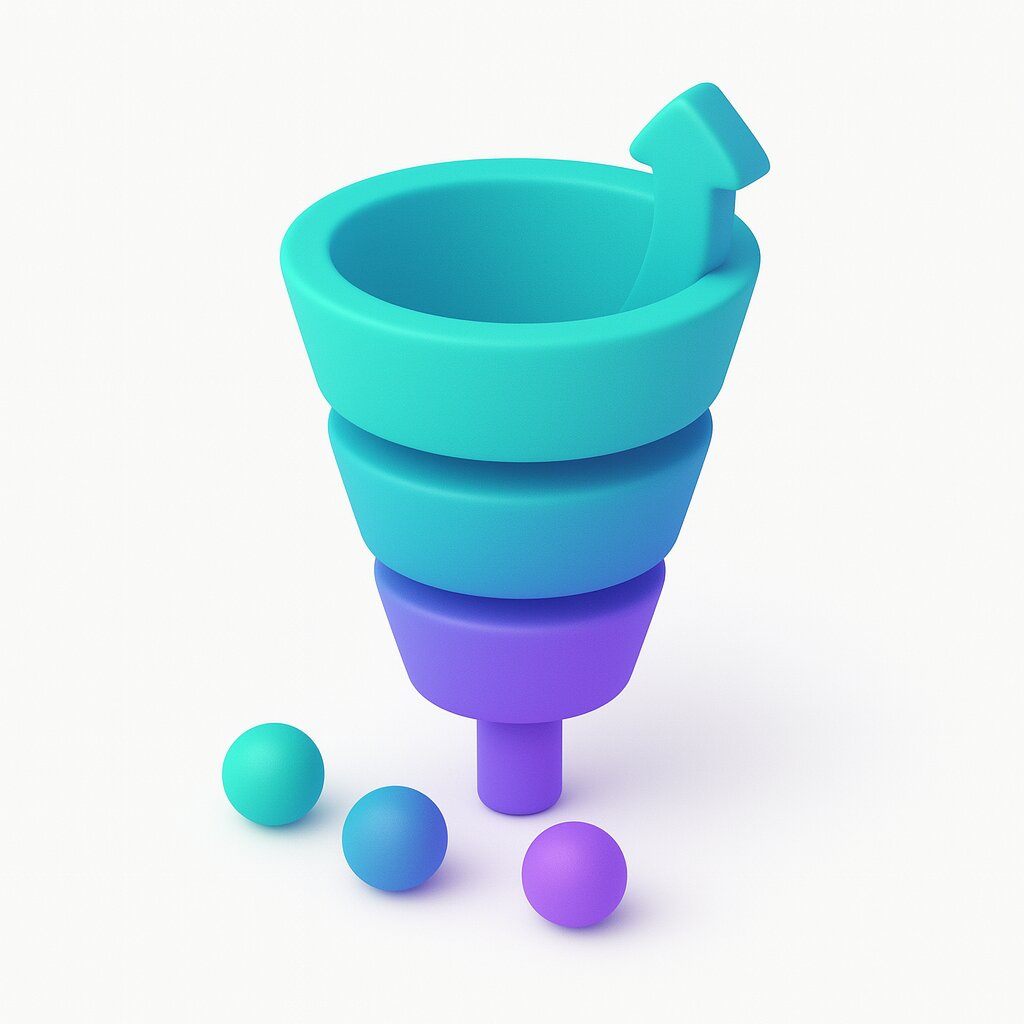
Let's get real: The marketing funnel isn't just another buzzword. It's the foundation of any successful digital marketing strategy. At its most basic, the funnel is comprised of four basic stages that mimic the way your customer makes a decision.
The awareness stage is at the top of your funnel (the widest part), and it's where people discover your brand. This is where the magic happens. As per Amazon's extensive study, brand awareness is everything including knowing your name, messaging, tone, value along with your culture. During this phase, your main focus is to capture leads and to pull people in to leave their information. We have learned that a combination of streaming TV ads, social media campaigns and content marketing delivers a potent awareness cocktail that works.
Further down we get into consideration where prospects are considering specific products or services. And then we get to the fun part. Your audience is distinguishing features, consulting reviews, considering their options. The goal here? Establish trust and provide the information potential customers require to make informed decisions. You have consumer testimonials, detailed use cases, webinars, educational resources that serve as your secret weapons. Recent statistics reveal that 79% of marketing leads never convert into sales, a lack of lead nurturing is the common cause of this poor performance.
The conversion stage is the moment of truth. The potential customers are warmed and ready to pull the trigger, they just need that final push. That's where strong calls-to-action, straight-forward checkout processes, and irresistible offers pay off. Product demonstrations, time-sensitive deals, and social proof can close the deal for you. The interesting part is that although the average funnel conversion rate is only 2.35% top funnels convert at 5.31% or higher, which also shows you that there is still a world of optimization that can be done once you hit performance plateaus.
And finally, we've got loyalty, which is after the sale. This critical phase is often overlooked by far too many Marketers, who are leaving the most profitable part of the funnel on the table. Generating repeat customers and advocates for the brand via loyalty programs, targeted communications, and superior customer service is not 'nice to have', it's required for growth. Pip & Nut case studies demonstrate how an emphasis on loyalty resulted in 133% growth in subscriptions and a 132% jump in repeat purchases.
How modern businesses leverage funnels for explosive growth
Then the proof is in the pudding, as they say. I'm going to give you some examples you can put into practise right away and even rethink your approach to marketing funnels.
Consider Sensibo, the climate technology company that employed a full-funnel strategy across ad solutions. And by focusing specifically on Sponsored Display and video advertising for upper-mid funnel (awareness), Sponsored Brands ads for mid funnel (consideration), and Sponsored Products forms the lower funnel (conversions), they delivered some truly jaw-dropping numbers. We're referring to a 111% YoY growth of NtB sales in the US alone. In Australia? They saw 184% growth. These are not flukes, they come from knowing and optimizing every part of the customer journey.
An illustrative application in the veterinary industry is also provided. Dr Ruth Roberts put a high converting sales funnel in place with a relaunch and a VSL (Video Sales Letter) involved which helped her to increase e-commerce conversions by 50%. What made the difference? She knew what her audience was going through, and she tailored content that spoke to her audience's pain points at every stage. The lesson here is this: when you match your marketing efforts with your customer's natural hiring timeline, the conversions will follow.
But maybe the most impressive results are from the Nielsen Marketing Study for Southeast Asian CPG brands. Through the use of integrated full-funnel strategies, they were able to realize a $2.3 total return on ad spend (ROAS) that synthesized short-term and long-term effects. What's even more interesting is that they found that full-funnel campaigns led to 2.2x more long-term sales impact than single-stage campaigns. Bottom line: it pays to think holistically about your funnel.
i"The marketing funnel isn't just a theoretical framework, it's the operational blueprint that transforms chaotic customer interactions into predictable revenue streams. After two decades in digital marketing, I've seen businesses triple their conversion rates simply by understanding and optimizing each funnel stage."
— Tessar Napitupulu, CEO of Arfadia and Digital Marketing Expert
5 game changing advantages that redefine your marketing ROI
1. Regular earnings from optimized solutions
If these are the things we are counseling our clients on at Arfadia, think first about making your income predictable. A well-built marketing funnel turns random sales into a fixed, measurable system. You can accurately predict revenue by knowing what percentage of leads move through each stage.
If you know, for example, that 1,000 visits typically yield 50 leads (5% conversion), and 10 of those leads typically become customers (20% close rate), you can reasonably project that driving 10,000 visits will result in approximately 100 new customers. This predictability makes it easier to plan your budget more intelligently and plan your business future with confidence. We have seen customers use this strategy to fund raise, forecast inventory and to hire and scale their teams efficiently.
The actual potency arises from compound gains. Match the industry average (conversion rates also vary by industry), and you're 20% more leads richer without spending another dime on traffic. According to HubSpot's latest research, businesses who practice a systematic approach to funnel optimization see an average of 23% revenue growth in the first year.
2. Laser-point targeting that lowers user acquisition costs
Here's a stat that might shock you: 61% of businesses simply throw their marketing budget out the window by marketing to the wrong people or at the wrong time. A well-configured marketing funnel literally inverts that formula. When you split your audience by funnel stage, you send the right message at the perfect time.
Top-of-funnel audiences require educational content that solves their problems, not product sales pitches. We share product comparisons, detailed comparisons and social proof to our middle-of-the-funnel prospects. Bottom-of-funnel leads require that last push: a stronger offer or risk reversal. But when you marry your messaging to the right funnel stage, something elemental happens: your cost per acquisition plummets and your conversion rates skyrocket.
We've just done this for a B2B software company: Our latest success was re-configuring campaigns for funnel stage. The result? Their cost of customer acquisition decreased by 43% and the quality of leads skyrocketed. They were no longer throwing money at bottom-funnel ads to cold audiences and instead committing to stage-appropriate content that genuinely connected.
3. Increasing customer-level visibility and insights for innovation-enabled growth
Your marketing funnel is more than a giant sales tool. It's a treasure trove of customer information. It provides valuable insights into what your audience wants and more about what they will they are currently doing from the context of initial awareness throughout the post-purchase behavior. This data serves as the basis for product and service innovation.
Recent industry analysis says that companies that are deeply engaged in funnel data analytics are 2.4x as likely to have successful new product launches. Why? Because they know precisely where customers get stuck, what questions they ask and, crucially, what finally makes them decide. This deeper empathy leads to better product, more effective marketing, and stronger competitive positioning.
We suggest our clients review their funnels often to analyze where people are dropping off or where conversion obstacles exist. One e-commerce client found that 67% of its cart abandonments occurred at the shipping calculation page. They addressed this friction point with free shipping thresholds and recouped $1.2 million in annual revenue that was quite literally walking out the door.
4. Scaleable growth engines that compound in value over time
And the wonderful thing about a well-oiled marketing funnel is that it's scalable! Unlike randomness, with funnel-based strategies you begin to earn interest in the rear of the funnel based on the initial marketing investment. Each successive optimization is based on the previous one, which would allow for exponential growth. Here is where growth hungry marketers get really excited.
Consider the fact that increasing your email open rate by just 5% may seem insignificant, but alongside a 3% increase in click-through rates and a 2% boost in conversion rates, you've increased your email revenue by 30% or more. Those compound effects multiply throughout every channel and touchpoint of your funnel.
According to marketing automation statistics, companies that use targeted funnel automation achieve a 34% increase in average growth rates each year as opposed to a 12% growth rate when funnel automation processes were developed on an ad-hoc basis. The difference? Random strategies never work when you can systematize the optimization.
5. Advantage through better customer experiences
The environment Velocity Customer experience is the ultimate differentiator in today's crowded marketplace. A carefully crafted marketing funnel sees that each interaction is valuable, trustworthy, and bringing people closer to their goals. Not only is this a win for customers, but it is also a powerful competitive weapon.
Businesses with well-optimized funnels have 73% more satisfied customers and 82% better retention than their peers concentrating solely on acquisition. Why such dramatic differences? Why funnel optimization makes you look at marketing the way your customers do. You cease pushing products for good and start solving problems. You stop interrupting and start adding value.
Our experience tells us that when companies prioritize full-funnel customer experience, the results can be spectacular. A healthcare client reworked their funnel to address patient anxiety at each stage. The outcome? They went on to dominate their market in their region within just 18 months with word-of-mouth referrals from happy patients who felt well and truly heard throughout their process.
Your burning marketing funnel questions, answered
What's the difference between a marketing funnel and a sales funnel?
Wonderful question, a lot of experienced marketers get tangled here. Although it's common for people to use the terms sales and marketing funnels loosely, they actually serve different functions within your revenue engine. The marketing funnel aims to attract, inform, and nurture prospects until they're ready to purchase. It includes everything from the first blog post they stumble upon to the email sequences that retain them. Consider it a program for warming strangers to became qualified leads.
The sales funnel, conversely, takes things further than marketing. It's the process of converting qualified leads into paying customers, through direct sales efforts, such as demos, proposals, negotiations, and closing. In B2B businesses, marketing might control the funnel through MQL (marketing-qualified lead), while sales takes it from SQL (sales-qualified lead) to close. The secret is serving the interconnected funnels with seamless handoffs. According to Harvard Business research, businesses with connected marketing and sales funnels experience 38% higher win rates and 36% better customer retention.
How can I track marketing funnel performance?
To measure funnel effectiveness, you first need to establish precise metrics for each one of these stages. My recommendation is to track both volume metrics (how many people) and conversion metrics (what percent advances) at each level. For the awareness stage, track unique reach, web traffic, and brand search volume. For good measure, keep track of your email engagement rates, your content downloads, and time spend with your brand. Conversion metrics are sales conversion ratios, average order values, and cost of customer acquisition.
But here's the punchline, don't measure each metric in isolation. The magic comes when you consider the relationship among stages. Should awareness rise but consideration plummet, you could be hoovering up the wrong people. If attention is good but conversion is poor, you have a sales process problem. With your CRM data, tools like Google Analytics 4 help you get these insights. Pro tip: Measure your overall funnel speed, how fast prospects move from awareness to making a purchase. The most recent benchmarks on conversion prove that if you decrease your funnel velocity by 10% you can fill your pockets with more than 25% extra revenue.
What are some of the biggest mistakes companies make when it comes to marketing funnels?
Having reviewed hundreds of marketing funnels, we've isolated three killer mistakes that kill success. There are two reasons for this: First, the "one-size-fits-all" mentality that treats all leads the same, even if they're at different stages in their need of your funnel. This passive approach is why as much as 96% of visitors abandon your site without converting. Educate and inspire with your awareness-stage content, don't sell. Reserve the hard pitch for when prospects are truly in buying mode.
Second, neglecting the post-purchase experience. The problem is too many marketers view the funnel as ending at conversion. Wrong! The loyalty phase is where the money is made. It's 5-25x more expensive to acquire a new customer than retain an existing one, but the average company spends 80% of their budget on acquisition. Smart marketers reverse this equation and concentrate on making the post-purchase experience unremarkable, in a good way that drives referrals and repeat business.
And finally, not experimenting and data-optimizing. We watch businesses build their funnels and then … silence. They don't test, they don't iterate, they don't get better. Meanwhile, their competition is running A/B tests, studying user behavior, and iterating rapidly. The result? A growing gulf that ultimately cannot be overcome. As a computer if you will, it needs constant feeding and nourishment.
How long before we can expect to see results from funnel optimization?
Let's set realistic expectations here. Not all improvements to your marketing funnel will produce instant impact, creating a fully optimized marketing funnel is a marathon, not a race. Quick wins are often 30-60 days out, that could be better email open rates, getting more conversions on your landing page, higher engagement on your content. These victories simply provide greater momentum and are proof that your efforts are meaningful.
The biggest benefit lead craps can attract better-quality leads and more when viable leads would go unnoticed otherwise and often these short to medium-term results, such as better quality leads and higher conversion rates, can show after 3-6 months. This is when your nurture sequences do their thing, your content ranks on search engines, your messaging resonates on a level deeper than it was before. You'd expect customer acquisition cost to fall and life time value to go up in this phase.
The actual transformation comes at, say, Month 6-12. This is where the compound effects come into play, the referral engines fire up, and your funnel becomes a legitimate competitive advantage. Performance benchmarks indicate that companies focused on ongoing funnel optimization experience an average of 73% Y-o-Y increase in revenue by the end of year two. It is patience that is required along with relentless testing and refining.
Do I need funnels separated by products or customer segments?
Absolutely! In reality, it's akin to trying to hang a picture with a sledgehammer: it works, but far from the most elegant option out there. We highly recommend creating separate funnels for your main product lines and customer personas. Here's why this method works best.
There are different levels of complexity, prices, and sales cycle for different products. A $50 a month SaaS subscription needs a different funnel than a $50,000 enterprise software implementation. Likewise, unique pain points, decision criteria, and buying process separate and divide customer segments. A founder at a startup assesses a solution differently than a Fortune 500 procurement team would. You can fix these types of issues and drastically increase your conversion rates by segmenting and targeting funnels.
That said, don't go overboard. Begin with 2-3 foundational funnels for your most crucial segments. Leverage commonality wherever you can, brand messaging, visual treatment, core value propositions, while tailoring content and conversion paths for each stage. And we have had clients double and triple their conversion rate across the board by moving from a single "generic" funnel to 3 targeted funnels. The extra work pays huge dividends.
How is AI integrated into the marketing funnel today?
The concept of the marketing funnel is being upended by artificial intelligence in ways we never anticipated when I first entered the new-media industry 20 years ago. These days, 43% of marketers use AI for content and 34% for research and insights. But we're only beginning to tap AI's potential to supercharge funnel performance.
AI is great at pattern recognition and prediction, so it's a very useful tool for understanding customer behavior and for optimizing your funnel flow. Artificial intelligence can help identify which leads are most likely to turn into paying customers, when leads are at the right moment to buy and what language will resonate. This isn't science fiction, it's already happening. We're analyzing thousands of customer interactions using AI-driven tools, and we've found hidden patterns where human marketers missed.
Perhaps most intriguing is the way AI can allow for real personalization at scale. Rather than speaking to segments broadly like segments did, AI can create tailored experiences for each prospect based on their behaviour, preferences, and stage in the funnel. To explore how AI could help in that space, I recently co-authored a new study on how AI personalization research can lift conversion rates by up to 202%. As we continue into the future, the era of AI is not about to replace human marketers, it will only enhance and unleash the powers of human marketers to drive funnel optimization like we've never seen before.
What is the impact of privacy regulations on marketing funnel strategies?
Privacy laws such as GDPR and CCPA have completely shifted the way we view marketing funnels, but really? It's been a positive transformation. These are laws that now compel marketers to be more honest, ethical and value oriented in their strategy of funnels. Those days of hard retargeting and shady data practices are behind us, and let that be a good thing.
How can brands succeed in this privacy-first world? Replacing the dependence on third-party data with first- and zero-party data strategies is a good place to start. This involves forming powerful value propositions that drive potential clients to share information willingly. We don't chase our visitors around the web, instead we focus on earning their trust through innovative tools and content. Interactive quizzes, assessment quizzes and useful guides are powerful funnel assets that allow you to gather information ethically.
Ironically, businesses that use a privacy-first strategy for funneling often end up with better outcomes. Why? Because transparency breeds trust, and trust is the foundation of most forms of conversions. We've assisted clients in remaking their funnels centered around consent and clear value propositions, leading to higher-value leads and deeper customer relationships. For privacy-first marketing studies, show that privacy-compliant funnels actually convert 23% better, and that's without being sleazy and side-eying your customers. The future of marketing funnels is permission-based, value-based, sincere.
Understanding the marketing funnel ecosystem
The marketing funnel does not appear in a vacuum, it is one of many other related marketing concepts and strategies in existence. Knowing these interconnections enables you to create more advanced and efficient marketing plans.
Sales enablement is the ultimate link between marketing and sales funnel. It's all the tools, content, and processes that enables sales teams to effectively engage prospects that have been nurtured by marketing. It's the plumbing that connects the dots between smooth handoffs and consistent messaging across the customer journey. Done right, sales enablement can increase bottom-of-funnel conversion rates by 35% or more.
More than just the funnel, the customer journey is a more encompassing view. Whereas funnels are all about conversion, customer journey mapping is about every touch, feel and emotion along the entire journey. This comprehensive perspective uncovers chances to deliver remarkable experiences that set your brand apart. Contemporary marketers employ journey mapping to discover friction points and moments of delight that can push happy customers into passionate advocates.
Lead scoring injects smarts into your funnel by allowing you to gauge where prospects are in their readiness to buy. By assigning numerical values to different behaviors and attributes, you can determine which leads should be swarming and which require further nurturing. Highly complex lead scoring models utilize explicit information (form fills, content downloads) and implicit information (email engagement, website behaviour) to accurately predict the likelihood to convert.
The buyer's journey is the path that the customer takes from the time they start thinking about a purchase, to when they make the purchase. i.e. Their buying process, or the process that they go through in their head. It is divided into three stages: Awareness, Consideration and Decision. It's like the marketing funnel but focused on the perspective of your lead rather than the goals of your company. Whilst you can draw these out it will help to have a detailed definition in place to help you come up with a marketing strategy that truly serves their needs (and that you can feel good about).
Related Terms
- Conversion Rate Optimization (CRO) - Systematic process of increasing percentage of visitors who convert into customers
- Lead Generation - Process of identifying and attracting potential customers through various marketing channels
- Customer Journey - Complete experience customer has with brand from awareness to purchase and beyond
- Buyer Persona - Detailed semi-fictional profile representing ideal customer based on research and data
Tips from the pros for marketing funnel success
Here are the hardcore tactics that separate excellent marketers from simply good ones: As we've learned, having optimized hundreds of funnels now and working on hundreds more, we've seen that the advanced tactics are what set the great marketers apart from the merely good. These are not theoretical concepts, these are things that have repeatedly returned stellar results.
Micro-conversions optimization is one of the least used strategies in funnel optimization. Rather than only looking at last conversions, track every tiny "yes" a lead says on their way to becoming a customer. Newsletter signups and content downloads, video views and social shares all show that more people are beginning to engage. From these micro-conversions, you build momentum that drives macro-conversions. We've had clients that have doubled their closing ratio just by improving micro-conversions in the early stages by 20%.
That is behavioral trigger automation that shifts your funnel from static to dynamic. Today's marketing automation platforms can react in realtime to prospect behavior with perfectly timed messages that seem to be almost psychic. But that's just as far as abandoned cart sequences go. Think about triggers such as: visits a pricing page 3 times (send them a discount), has downloaded more than 2 case studies (schedule a demo invite), or went silent for 30 days (re-engagement campaign). The key is too map actions to appropriate responses that add value, not annoyance.
Content velocity matching ensures the rate of your content creation synchronize to how your prospects want to consume. Marketers mostly produce content randomly and pray that some of it sticks. Intelligent marketers calculate how fast their prospects travel across every single funnel stage and develop content based on that. If a qualified lead typically takes 2 weeks to mull their options, you'll need at least 2 weeks of good-content from the tail-between-the-legs visitor to get them to convert. By using this strategic approach, you will avoid both content gaps (loss of traction) and content overload (overwhelming your prospects).
Conversion rate optimization (CRO) is not a project, but instead an ongoing process. Execute on a systematic testing program for everything in your funnel. Begin with high-impact elements such as headlines, calls-to-action, and form fields. Leverage heatmaps and session recordings to track user behavior. But here's the key, test with an agenda. Make clear assumptions, conduct statistically relevant experiments, and write what you've learned. Even failures offer comprehensive understanding to help direct further ongoing optimization efforts.
Full-funnel attribution modelling solves the biggest marketing problem: proving a return on investment. There is a time lag between most touchpoints and the conversion event also known as the conversion window. Single touch attribution strategy models (First-touch, last-touch) give half-baked information. Use multi-touch attribution so that credit is applied where it's due to every funnel interaction. It uncovers the channels, and individual content pieces that are consistently driving revenue, and can be used to allocate your spend much more intelligently. Yes, it's hard to get working, but the knowledge is worth its weight in gold. We've helped our clients realize that the channels that they thought were "bad performers" were actually important for initiating the customer journey.
The future of marketing funnels begins right now
As we conclude this detailed guide, let's get one thing perfectly straight: the marketing funnel isn't dead, it's evolving. Although some commentators argue that today's customer journeys are too sophisticated for funnel-based models, we beg to differ. Well, the funnel is still an incredibly useful way to understand and optimize customer acquisition. What's changing is how we use it in a digital, AI-powered, privacy-aware world.
Those who succeed in the future and thereafter will be those who innovate in the funnel while adhering to principles grounded in the distant past. They'll employ artificial intelligence to augment human creativity, not replace it. They will focus on customer value instead of short-term conversions. They will build funnels which will be context-specific and will respect privacy preferences. But most of all, they will never stop testing and learning and constantly optimizing.
Here at Arfadia, we have committed to helping businesses grow alongside these changes in the digital world. No matter if you're building your very first funnel, or tweaking an existing one, just keep in mind that success is a direct byproduct of having a deep knowledge of your customers and catering to them exceptionally at every turn. The tools and the tactics will always shift, just as they should, but this fundamental principle does not.
Your marketing funnel is about more than just the business end of things, it's your chance to build those critical relationships with customers and see lasting results. Now that you have a solid understanding of building funnels, armed with the knowledge in this how-to guide, you can build funnels that do more than just convert leads into customers, they build relationships that are profitable for everybody. One optimized touchpoint is all that it takes to start the journey of a thousand conversions. What are you waiting for?
References:
- National Institutes of Health - The buying funnel model in medical research
- Amazon Ads - Complete guide to marketing funnel optimization
- HubSpot - State of Marketing Report: Latest statistics and trends
- Nielsen - Marketing Mix Modeling Study: Full-funnel advertising impact
- Harvard Business School - Faculty research on full-funnel advertising strategies
- Single Grain - Case studies of successful marketing funnel implementations
- First Page Sage - B2B SaaS funnel conversion benchmarks and analytics
- Wikipedia - Purchase funnel: Historical development and modern applications
- Library of Congress - Marketing automation and funnel management research guide
- ContentGrip - Future of marketing: AI and automation trends analysis
- Saffron Edge - Marketing automation trends and predictions
- Pennsylvania State University - Digital marketing funnel optimization strategies
