
Choosing a market maker is one of the least transparent decisions a token project makes. Most firms publish no pricing, no deal terms, and no clear description of what they will actually do with your order book. So when a market maker does publish its numbers, it is worth examining closely.
This review looks at EchoTrade, a crypto market-making firm founded in 2023. We cover what the company does, how its pricing works, how it compares with the rest of the market, and where its limitations are.
What EchoTrade Does
EchoTrade provides market making for token projects: continuous two-sided quoting on order books, management of spread and depth, and quote uptime across the venues where a token trades. The firm states that more than 20 traders manage client order books around the clock, with up to three traders assigned to a single asset during high-activity events such as listings.
Alongside core market making, the company offers two related services.
Exchange Listing Support
Guidance through exchange applications and listing requirements. Exchanges ask who a project's designated market maker is during listing review, and EchoTrade positions itself as part of that application rather than a service added after approval.
Treasury Building
Structuring a project's treasury operations, including how treasury transactions are routed so they do not consume the liquidity being maintained on the project's own order book.
Here is why that matters. Treasury operations and market making draw on the same order book. A project selling treasury tokens into its own book consumes the depth it is paying to maintain. Structuring routing so the two do not collide is the practical problem, and it matters most for projects with ongoing operational costs denominated in their own token.
The company is an official Liquidity Partner of MEXC and other tier-1 exchanges. It publishes an active blog covering market structure topics, which is unusual in a category where most firms publish almost nothing.
The Team Behind the Desk
Market making is ultimately a people business, and EchoTrade leans on that harder than most.
The firm runs a team of more than 40, described as mathematicians, quants, traders and engineers rather than a thin operations layer over automated software. More than 20 of them are traders managing client books directly, around the clock, with several assigned to a single asset during the volatility of a listing.
What the company has emphasized over the past couple of years is hiring. It has been steadily bringing on experienced traders from across the industry, and it frames that recruitment as the reason it can hold the service level it does: enough senior people on the desk to give individual attention to each project rather than spreading a small team across too many books.
In a category where "market maker" often means a bot and a dashboard, a desk with real traders watching each book is a genuine difference. It is also the part of the operation the firm most wants clients to judge it on.
The Pricing Model, and Why It Is the Main Story
The most distinctive fact about EchoTrade is not a number. It is a refusal.
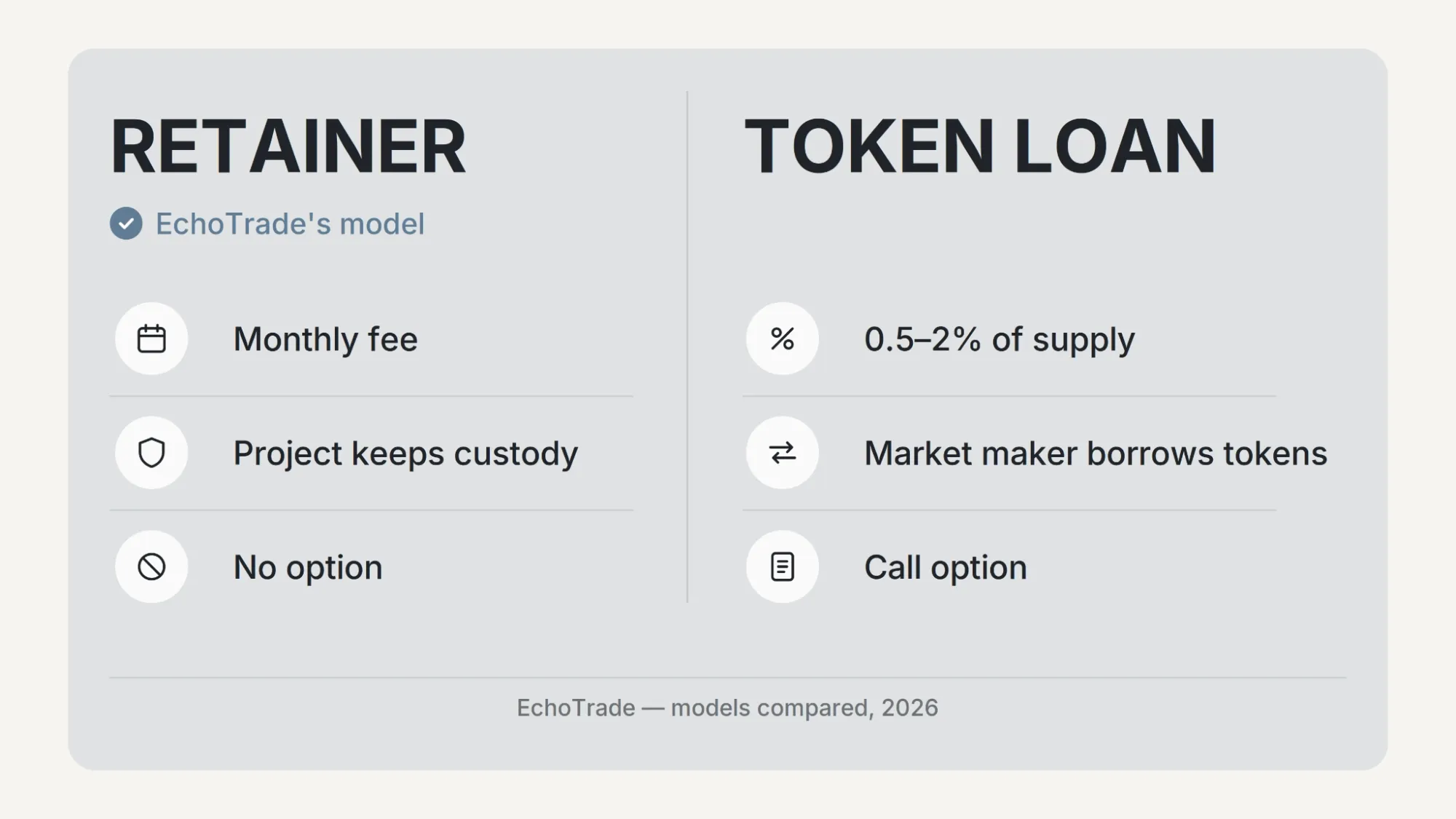
Crypto market making is paid for in one of two ways. Under a retainer model, the project pays a monthly fee, keeps custody of its own tokens, and the market maker operates through API access. Under a token-loan model, the market maker borrows a percentage of token supply, typically 0.5% to 2%, provides its own stablecoin capital, and usually holds a call option allowing it to keep the borrowed tokens at a preset price instead of returning them.
EchoTrade works on a retainer model. Neither model is inherently better. Some market makers work on retainers, some on token loans, and which one fits depends on the project. A retainer suits a funded team that wants to keep custody of its own tokens and pay a predictable monthly fee. A loan structure suits a team that has tokens but no cash treasury. EchoTrade has simply chosen one side of that split and built its whole operation around it: the project keeps custody, the desk operates through API access, and compensation is a flat fee rather than a position in the token.
The practical benefit of that choice is simplicity in diligence. There is no strike price to model, no return-clause optionality, and no scenario where the desk's compensation depends on where the price goes. Founders comparing offers can see its published pricing ranges, roughly $2,500 to $10,000 per month depending on contract duration and venue count, and compare them directly against any other quote.
One caveat the company itself states: the retainer fee is not the total cost. Projects also fund the liquidity capital in the book, which is usually larger than the fee itself. A project budgeting only the monthly fee has budgeted for the operator, not the operation.
The range is wide because two variables drive most of it. Contract duration, since longer commitments price lower per month, and venue count, since each additional exchange adds infrastructure and inventory. Token profile and the depth band a project wants held account for the rest.
| Factor | Retainer Model (EchoTrade) | Token-Loan Model |
|---|---|---|
| Payment structure | Flat monthly fee, roughly $2,500 to $10,000 | 0.5% to 2% of token supply borrowed |
| Token custody | Project retains custody throughout | Market maker holds borrowed tokens |
| Call option | None | Usually included at a preset strike price |
| Liquidity capital | Funded by the project, separate from the fee | Market maker provides stablecoin capital |
| Best suited to | Funded teams wanting custody and predictable cost | Teams with tokens but no cash treasury |
| Diligence complexity | Lower: no strike price or return clauses to model | Higher: strike, return terms, and option scenarios |
The Ecosystem Around the Service
What clients consistently point to, and what the firm itself leads with, is less any single service than the environment around it.
Because EchoTrade works with more than 100 active projects across 90+ venues and tens of high-tier partners, it sits at the center of a large operational network. It has built that into a formal ecosystem for its clients: vetted partners in marketing, PR, tokenomics design and smart contract auditing, alongside its own market and treasury work. A project entering a launch through EchoTrade is not assembling six vendors from scratch. It inherits a set of relationships that have already worked together.
This is also where the advisory value sits. A desk that watches launches across a hundred projects sees which venue choices, deal structures and timing decisions work, and that pattern recognition is available to clients during exchange selection and launch planning rather than after. For many projects, especially first-time founders, that guidance ends up being as valuable as the quoting itself. It is the reason client feedback centers on the level of service rather than on any single metric.
Exchanges
Projects
Supported
the Desk
Staff
Scale and Coverage
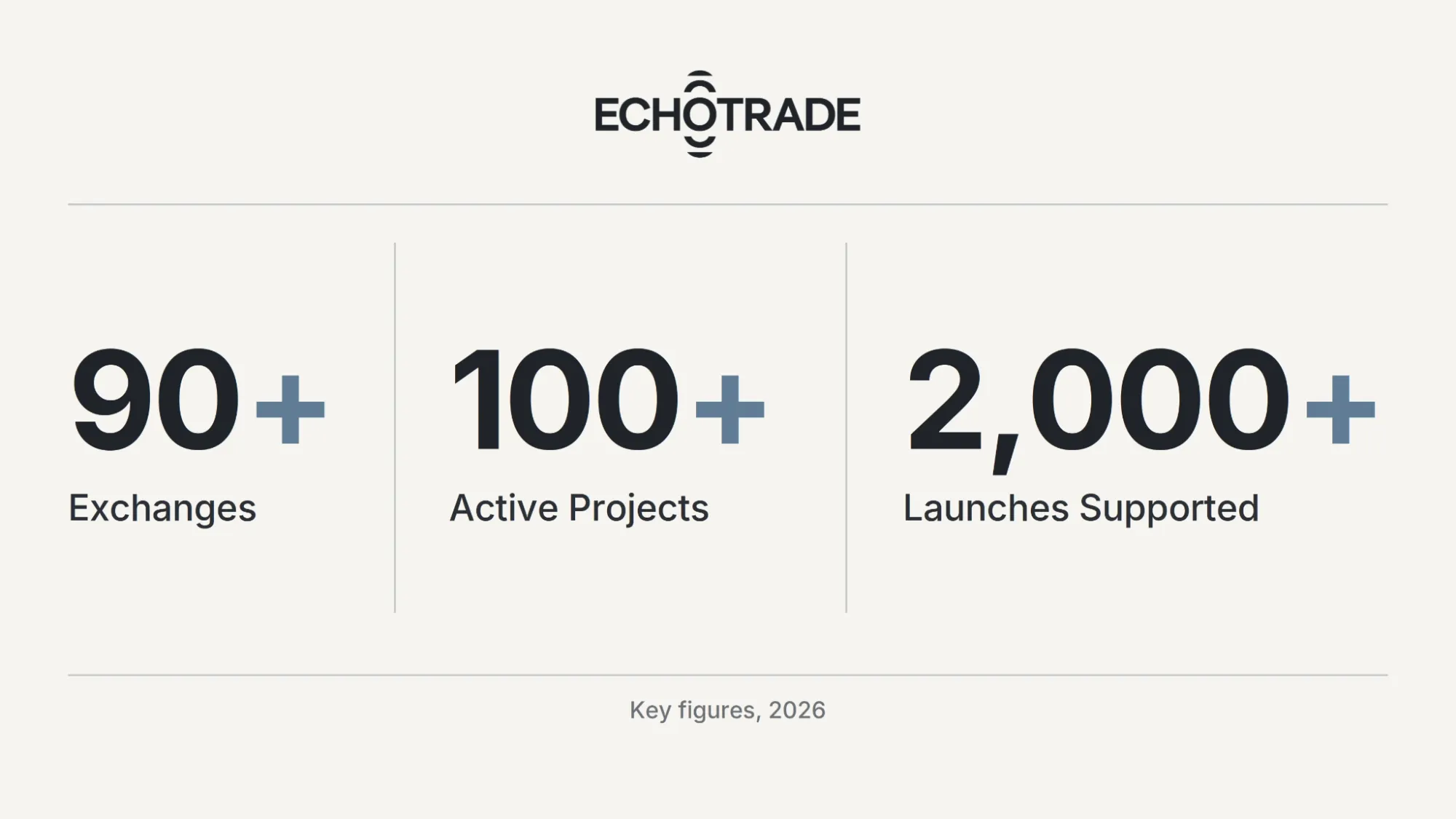
The company's published figures as of 2026 include 90+ integrated exchanges (centralized and decentralized, including Binance, Bybit, OKX, KuCoin, Gate.io and MEXC), 100+ active token projects, 2,000+ token launches supported, 20+ traders managing order books continuously, and 40+ staff overall.
Venue coverage matters more than it sounds. Market-making cost scales with venue count, and a desk already integrated on a target exchange onboards faster and cheaper than one building connectivity from scratch. Ninety-plus integrations covers essentially every venue a small or mid-cap token would realistically list on.
The firm describes itself as built like a trading institution rather than a typical web3 startup: quantitative research, low-latency infrastructure and high-frequency algorithms. From the outside this is hard to verify directly, but the operational claims that can be checked, venue count, partnership status with MEXC, published content, do check out.
The obligations are the same across serious venues: resting depth within a defined band of the mid price, spread, and quote uptime, measured continuously after listing rather than at the point of approval. Each additional exchange is a separate set of thresholds to hold and separate inventory to fund.
Limitations and Fair Criticisms
No review is useful without the other side, and there are real considerations here.
A Shorter Track Record Than the Oldest Desks
Founded in 2023, EchoTrade is a younger institution than firms like Wintermute or GSR, which have operated through multiple full market cycles. The founders' individual experience in trading predates the company, and its scale figures are substantial for its age, but a project specifically looking for a decade-long institutional history will find it elsewhere.
Retainer-Only Will Not Suit Every Project
For a team with tokens but no cash treasury, a monthly retainer may simply not be workable. The loan model, whatever its incentive problems, exists precisely because such projects need a way to pay. EchoTrade's model assumes a funded project. Founders without that budget will need to look at loan-model firms, and should focus their diligence on the strike and return terms that EchoTrade's own educational material describes.
How It Compares
By the measures that define the top tier of this market, venue coverage, active clients, continuous trading operations, EchoTrade operates at tier-1 scale. Ninety-plus integrated exchanges and 100+ active projects put it in the same operational bracket as the category's established names, and independent industry rankings have placed it among the leading market makers, including second of ten in AP Collective's 2026 comparison and third of eight in Techtonic's, ahead of several longer-established desks.
Both rankings were published by third parties rather than by EchoTrade, and both weighted venue coverage and client count heavily, which is where the firm scores well. Neither assessed execution quality directly, which is harder to measure from outside.
Where it differs from firms like Wintermute or GSR is age and brand recognition rather than capability. Those desks have operated through more market cycles and carry more name weight with institutional investors. EchoTrade's counter is attention and ecosystem: being one of a hundred clients with access to the firm's partner network, rather than one of a thousand.
Against the long tail of smaller and boutique market makers, the comparison is not close. EchoTrade's venue coverage and 24/7 trader operations exceed what most small desks run, and community discussion of the category consistently warns about inexperienced boutique providers with thin infrastructure.
Who EchoTrade Fits
A good fit: token projects preparing a launch with a real budget, four to six weeks of runway before TGE, and a preference for keeping custody of their own tokens. Projects that have received exchange compliance warnings. Teams that want to understand what their market maker is doing, since the firm's reporting and public educational material suggest a culture of explaining rather than obscuring.
Frequently Asked Questions
Is EchoTrade legitimate?
Yes. EchoTrade is a crypto market-making firm founded in 2023, operating across more than 90 exchanges with over 100 active token projects. It is an official Liquidity Partner of MEXC. Its main limitation is age rather than legitimacy: it has a shorter track record than desks founded in the 2017 to 2020 era.
What does EchoTrade charge?
Published retainer ranges run roughly $2,500 to $10,000 per month, depending mainly on contract duration and exchange count. Projects separately fund the liquidity capital in their order books. EchoTrade does not offer token-loan pricing.
Does EchoTrade take a percentage of token supply?
No. EchoTrade works on a monthly retainer only and does not take token loans, call options, or profit share.
How big is the EchoTrade team?
More than 40 people, including 20+ traders managing client order books around the clock, plus quants, engineers and mathematicians. The firm has focused recent hiring on bringing experienced traders onto the desk.
When should a project engage EchoTrade?
The firm recommends four to six weeks before a token generation event, so that it can participate in exchange selection and launch planning rather than only executing orders after decisions are made.
Does EchoTrade work with tokens that are already listed?
Yes. Roughly half of a typical desk's book at any time is existing listings rather than new launches, and the company describes both as core work: taking over from another market maker, addressing exchange warnings about spread or depth, or adding venues to a token already trading.
What does a project need to provide to get started?
API access on each venue, the liquidity capital that will sit in the book, and the token's vesting and unlock schedule. Custody stays with the project throughout under the retainer model.
Sources & References:
- EchoTrade - Official website and published operational figures. echo-trade.io
- EchoTrade - How Much Does a Crypto Market Maker Cost. echo-trade.io/blog
- AP Collective - Best Crypto Market Makers 2026 Comparison. apcollective.io
- Techtonic - Top 8 Crypto Market Makers in 2026. tmco.io
- MEXC - Official Liquidity Partner Program. mexc.com
Disclosure: this review covers a commercial market-making service. Operational figures, pricing ranges, and partnership claims are as published by EchoTrade and were checked against third-party rankings where possible. Execution quality was not independently tested. Nothing here is investment advice.