What is A/B Testing? Complete Split Testing Guide

What is A/B Testing? The Complete Breakdown
A/B Testing is essentially the scientific method applied to marketing. Think of it as the marketing world's version of a taste test – except instead of asking "Coke or Pepsi?", you're asking "Red button or blue button?" and letting the data do the talking.
At its core, A/B Testing involves:
- Creating two variants of the same marketing element
- Splitting your audience randomly between the versions
- Measuring performance against predetermined goals
- Implementing the winner based on statistical significance
This methodology eliminates guesswork and personal preferences, replacing them with cold, hard data. As conversion optimization expert Peep Laja from CXL puts it: "Opinions are like belly buttons – everyone has one, but they're not all useful. A/B testing turns opinions into evidence."
The Science Behind A/B Testing
A/B Testing relies on statistical significance to ensure results aren't just random chance. According to research by Optimizely, companies that consistently run A/B tests see conversion rate improvements of 10-25% on average. The process works because it controls for external variables while isolating the impact of specific changes.
How A/B Testing Works: Step-by-Step Process
1. Hypothesis Formation
Start with a clear hypothesis: "If I change [specific element], then [expected outcome] will occur because [reasoning]."
Example: "If I change the CTA button color from green to orange, then click-through rates will increase because orange creates more visual contrast against our blue background."
2. Element Selection
Choose one variable to test at a time:
- Headlines
- Call-to-action buttons
- Images
- Email subject lines
- Landing page layouts
- Pricing displays
3. Audience Splitting
Randomly divide your audience into two equal groups:
- Control Group (A): Sees the original version
- Test Group (B): Sees the modified version
4. Data Collection
Run the test until you achieve statistical significance, typically requiring:
- Minimum sample size: Usually 1,000+ visitors per variation
- Test duration: At least one full business cycle (often 1-2 weeks)
- Confidence level: 95% statistical significance
5. Results Analysis
Compare performance metrics and implement the winning version.
Real-World A/B Testing Examples & Results
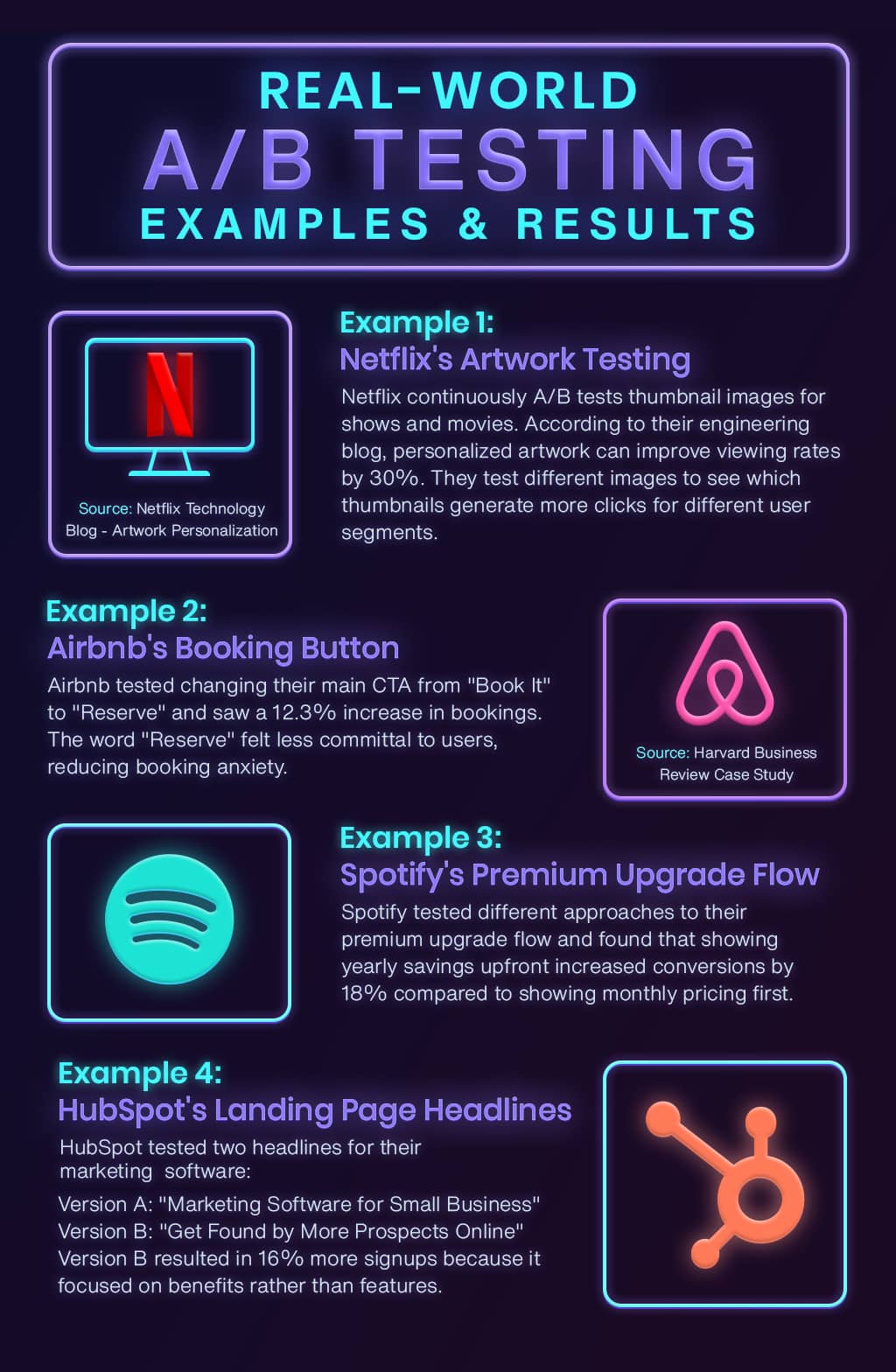
Example 1: Netflix's Artwork Testing
Netflix continuously A/B tests thumbnail images for shows and movies. According to their engineering blog, personalized artwork can improve viewing rates by 30%. They test different images to see which thumbnails generate more clicks for different user segments.
Source: Netflix Technology Blog - Artwork Personalization
Example 2: Airbnb's Booking Button
Airbnb tested changing their main CTA from "Book It" to "Reserve" and saw a 12.3% increase in bookings. The word "Reserve" felt less committal to users, reducing booking anxiety.
Source: Harvard Business Review Case Study
Example 3: Spotify's Premium Upgrade Flow
Spotify tested different approaches to their premium upgrade flow and found that showing yearly savings upfront increased conversions by 18% compared to showing monthly pricing first.
Example 4: HubSpot's Landing Page Headlines
HubSpot tested two headlines for their marketing software:
- Version A: "Marketing Software for Small Business"
- Version B: "Get Found by More Prospects Online"
Version B resulted in 16% more signups because it focused on benefits rather than features.
Real-World A/B Testing Results: Company Case Studies & Benchmarks
| Company | Test Element | Change Made | Result | Impact Level | Key Insight |
|---|---|---|---|---|---|
| Netflix | Thumbnail Images | Personalized artwork | +30% | High | Viewing rates improved |
| Airbnb | CTA Button Text | "Book It" → "Reserve" | +12.3% | Medium | Less committal wording |
| Spotify | Pricing Display | Yearly savings upfront | +18% | High | Value proposition clarity |
| HubSpot | Landing Page Headlines | Features → Benefits | +16% | High | Benefits over features |
| Industry Average | Various Elements | Successful tests | 10-25% | Medium | Typical improvement range |
| Best Performers | Page Layout Changes | Complete redesign | 25-50% | High | Highest potential lift |
Types of A/B Testing
1. Simple A/B Testing
Testing two versions of a single element.
2. Multivariate Testing (MVT)
Testing multiple elements simultaneously to understand interactions between variables.
3. Split URL Testing
Comparing completely different page designs or flows.
4. Multi-page Testing
Testing changes across multiple pages in a user journey.
A/B Testing Tools & Platforms
Free Tools:
- Google Optimize (discontinued 2023, but data still valuable)
- Facebook's built-in ad testing
- Mailchimp's A/B testing feature
Paid Platforms:
- Optimizely: Enterprise-level testing platform
- VWO (Visual Website Optimizer): User-friendly interface
- Adobe Target: Integrated with Adobe Marketing Cloud
- Unbounce: Specialized for landing page testing
Industry Data: According to CXL's 2023 survey, 67% of companies using A/B testing tools see ROI within 3 months of implementation.
Related Marketing Terms
Understanding A/B Testing connects to several key marketing concepts:
- Conversion Rate Optimization (CRO) - A/B testing is the primary method for CRO
- Statistical Significance - Critical for validating A/B test results
- Landing Page Optimization - Common application of A/B testing
- Email Marketing - A/B testing subject lines and content
- Call-to-Action (CTA) - Frequently tested element
- Customer Journey - A/B testing optimizes each touchpoint
- Bounce Rate - Metric often improved through A/B testing
- Click-Through Rate (CTR) - Primary measurement in many A/B tests
Frequently Asked Questions (FAQs)
What is A/B Testing in simple terms?
A/B Testing resembles a scientific experiment in marketing, wherein two distinct versions of a product (such as a webpage or email) are shown to separate groups to determine which variant performs more effectively.
How long should an A/B test run?
Most A/B tests should run for 1-4 weeks to account for daily and weekly variations in user behavior. The key is reaching statistical significance with adequate sample size, typically 1,000+ conversions per variation.
Check in A/B test sample size calculator
What's the difference between A/B Testing and Multivariate Testing?
A/B Testing compares two versions of one element, while Multivariate Testing examines multiple elements simultaneously. A/B testing is simpler and requires smaller sample sizes.
Can I test multiple things at once?
It's better to test one element at a time in A/B tests to clearly identify what caused performance changes. For testing multiple elements, use Multivariate Testing instead.
What sample size do I need for A/B Testing?
You typically need at least 1,000 visitors per variation and around 100-250 conversions per variation to achieve statistical significance. Use sample size calculators to determine exact requirements.
What if my A/B test shows no winner?
If results aren't statistically significant, either run the test longer, try a more dramatic change, or accept that the current version is performing adequately.
How much improvement should I expect from A/B Testing?
According to Optimizely's research, successful A/B tests typically show 5-30% improvement in conversion rates, with the average being around 10-15%.
A/B Testing Best Practices
1. Start with High-Impact Elements
Focus on elements that directly influence conversions:
- Headlines and value propositions
- Call-to-action buttons (text, color, placement)
- Forms (length, fields, layout)
- Images and videos
- Pricing displays
2. Test One Variable at a Time
Avoid the temptation to test multiple changes simultaneously. As growth expert Sean Ellis advises: "The beauty of A/B testing lies in its simplicity – change one thing, measure the impact, learn, and iterate."
3. Ensure Statistical Significance
Don't stop tests early due to exciting preliminary results. False positives can cost you real revenue. Wait for 95% confidence levels before declaring winners.
4. Consider External Factors
Account for:
- Seasonal variations (holidays, end-of-month, weekly cycles)
- Traffic source differences (social media vs. email vs. organic)
- Device and browser variations
5. Document Everything
Keep detailed records of:
- Test hypotheses and reasoning
- Exact changes made
- Results and statistical significance
- Implementation dates
- Lessons learned
6. Test Continuously
A/B testing isn't a one-time activity. According to CXL, companies running continuous A/B testing programs see 3x higher growth rates than those testing sporadically.
Source : CXL - State of Conversion Optimization Report 2020
A/B Testing Elements: Priority Matrix for Conversion Optimization
| Element Category | Impact Level | Test Difficulty | Average Lift | Implementation Time | Business Risk |
|---|---|---|---|---|---|
| Headlines & Value Props | High | Low | 15-30% | 1-2 days | Low |
| CTA Buttons (Text) | High | Low | 10-25% | 1 day | Low |
| CTA Buttons (Color) | Medium | Low | 5-15% | 1 day | Low |
| Form Length | High | Medium | 20-40% | 3-5 days | Medium |
| Pricing Display | High | High | 15-35% | 5-10 days | High |
| Page Layout | High | High | 25-50% | 1-2 weeks | High |
| Images/Videos | Medium | Medium | 8-20% | 2-3 days | Low |
| Navigation Menu | Medium | High | 10-25% | 1 week | Medium |
| Product Descriptions | Medium | Medium | 12-22% | 3-5 days | Low |
| Social Proof Elements | Medium | Low | 8-18% | 1-2 days | Low |
Common A/B Testing Mistakes to Avoid
1. Stopping Tests Too Early
The Problem: Getting excited by early results and implementing changes before reaching statistical significance.
The Solution: Set a minimum test duration and sample size before starting.
2. Testing Too Many Variables
The Problem: Changing multiple elements makes it impossible to identify what drove results.
The Solution: Focus on one primary variable per test.
3. Ignoring Mobile vs. Desktop
The Problem: Results may vary significantly between device types.
The Solution: Segment results by device and optimize accordingly.
4. Testing Insignificant Elements
The Problem: Testing minor details that won't meaningfully impact business goals.
The Solution: Prioritize high-impact elements that directly influence conversions.
Source : CXL
Advanced A/B Testing Strategies
1. Sequential Testing
Run related tests in sequence to compound improvements. For example:
- Test headline variations
- Test CTA button colors
- Test form lengths
- Test page layouts
2. Segment-Specific Testing
Different audience segments may respond differently. Test variations for:
- New vs. returning visitors
- Traffic sources (organic, paid, social)
- Geographic locations
- Device types
3. Personalization Testing
Use dynamic content to test personalized experiences based on:
- Past behavior
- Demographics
- Purchase history
- Browsing patterns
The Future of A/B Testing
AI-Powered Testing
Machine learning is revolutionizing A/B testing through:
- Automated test creation based on user behavior patterns
- Real-time optimization adjusting traffic allocation to winning variations
- Predictive analytics estimating test outcomes faster
Privacy-First Testing
With increased privacy regulations, the industry is moving toward:
- First-party data reliance
- Server-side testing for better privacy compliance
- Cookieless testing methodologies
Industry Prediction: According to Gartner's 2024 Marketing Technology Report, 85% of A/B testing platforms will incorporate AI-driven insights by 2026.
Conclusion: Why A/B Testing Matters
A/B Testing isn't just a marketing tactic – it's a mindset shift toward data-driven decision making. In an era where customer acquisition costs are rising and attention spans are shrinking, the ability to optimize based on real user behavior rather than assumptions is invaluable.
Companies like Amazon, Google, and Netflix built their empires partly through relentless A/B testing. As Amazon founder Jeff Bezos once said: "Our success at Amazon is a function of how many experiments we do per year, per month, per week, per day."
The beauty of A/B testing lies in its democratic nature – you don't need a massive budget or complex tools to start. You just need curiosity, patience, and a commitment to letting data guide your decisions.
Start small, test consistently, and remember: in the world of marketing, the best opinion is the one backed by data. Your customers are already telling you what they want – A/B testing just helps you listen.
Sources:
- Optimizely. (2023). "A/B Testing Statistics and Trends Report"
- CXL. (2023). "State of Conversion Optimization Survey"
- Netflix Technology Blog. (2022). "Artwork Personalization at Scale"
- Harvard Business Review. (2023). "The Science of A/B Testing"
- Gartner. (2024). "Marketing Technology Trends Report"
- VWO. (2023). "Conversion Rate Optimization Benchmarks"
