What is Ad Copy? Complete Guide to High-Converting Ads
The Basics of Ad Copy
First, it helps to understand that ad copy is much more than a clever line on a page. Ad copy is the text in any advertisement, from headlines and body copy to calls to action and even email subject lines. Unlike blog or social content, ad copy has one main job: to persuade the reader to take action, usually to buy or sign up.
The competition for attention is intense. Estimates of how many ads a typical American sees each day vary widely, from a few hundred to several thousand, depending on how an "exposure" is counted. Either way, your copy has to cut through the noise in a crowded digital marketplace where everyone competes for the same eyeballs.
What this means: one-size-fits-all ad copy no longer works. Every platform has its own formats, costs, and limits. Google Ads headlines are capped at 30 characters, and the common advice that Facebook ads limits you to 125 characters reflects how much primary text shows before it is cut off.
Tone matters too. You'll usually play the professional voice and tone card on LinkedIn, where heavy jargon doesn't always land, while on TikTok, you've got a little bit more licence to relax and write in a voice that matches the video.
Here's the truth: good ad copy doesn't just follow a platform's norms; it stays true to the brand voice and strategic message. Running the same message everywhere and expecting miracles rarely works.
The psychology behind unignorable copy
This is where it gets interesting. USC research says emotional ads tend to beat purely rational ones: its overview of advertising psychology cites a finding that 31% of ads with emotional pull succeeded, compared with 16% of ads focused on rational content. That is the essence of how effective ad copy works in the real world.
Research from the Wharton School used eye tracking and pupil measurements to study celebrity endorsements. People were more likely to choose celebrity-endorsed products, and they chose them faster and with more confidence. Authority cues work as a mental shortcut toward a decision.
i"On the average, five times as many people read the headline as read the body copy. When you have written your headline, you have spent eighty cents out of your dollar."
, David Ogilvy, "The Father of Advertising" & Founder of Ogilvy & Mather
.jpg "Ad Copy - Two Systems Emotional Rational - Arfadia")
Strong ad copy often draws on psychological triggers rooted in human nature: authority, scarcity, social proof, reciprocity, commitment, contrast, urgency, and personalization. Emotion matters: emotional ad copy tends to convert better than purely rational copy, as the study discussed below shows.
But here's the key point: the best campaigns don't choose between emotional and rational appeals. They pair emotional hooks with rational proof points, persuading on more than one level at once.
Research from Vanderbilt University proposes a new field, clinical consumer psychology, to study how traits and conditions such as anxiety shape consumer choices. For example, people with high separation anxiety respond differently to "coming home" ad messages. It is a reminder of why targeted, responsible messaging matters.
The science of persuasion, used responsibly
Let's be clear: advertising psychology is not about manipulation. It is about understanding how people process information and make decisions. Ad copy with emotion performs an average of 31 percent better, according to some summaries; Ranktracker's own study reports a 28% increase in conversion rates for emotional ad copy.
The buttons that people can't stop pushing:
Social proof: People follow the crowd, especially when they feel uncertain. Showing that others have already taken the step lowers perceived risk.
Scarcity: When availability is limited, fear of missing out makes us decide faster.
Authority: We trust experts and leaders, so credible expertise makes your message more believable.
Reciprocity: If you give people something of value first, they are more likely to give something back. This sense of obligation can turn into sign-ups or purchases.
Ad copy trends shaping today's market
The industry is changing fast as AI meets shifting consumer behavior. Mobile drives most digital ad clicks, and mobile users have 2-5 percent click-through rates compared with 1-3% on desktop, according to Enhencer. In a mobile-first world, copy must be short, scannable, and built for small screens and short attention spans.
AI-driven personalization is changing how copy is created
AI has changed how marketers write and test ad copy. With dynamic creative optimization, ad copy can be optimized automatically in real time based on user behavior, location, weather, or browsing behavior.
Dynamic creative optimization (DCO) lets you test many ad permutations automatically. Meta wants to go further: Meta's Mark Zuckerberg serves up an image of a future in which a brand supplies a product image, a budget, and a goal, and AI creates and targets the ads, with Meta reportedly aiming for this by the end of 2026.
But experts stress that AI still needs human supervision. Speakers at events such as the Marketing AI Conference 2024, run by Paul Roetzer's Marketing AI Institute, regularly argue that AI should augment people rather than replace them. Think of AI as a super-powered assistant, not a substitute, and find the right balance between efficiency and human creativity.
Platform-specific optimization
Each advertising platform has its own guidelines and best practices. Performance Max campaigns use machine learning to optimize automatically, and an analysis of more than a million ads reported by Search Engine Land found that a responsive search ads test of title case versus sentence case favored sentence case. Benchmarks help too: the average CTR in Google Ads was 6.42% in 2024, up about 5% year over year.
Facebook ad creative has shifted toward raw, authentic content over slick corporate messaging, and carousels remain popular for products. Video content performs 15% better is a common claim, but WordStream's trends roundup focuses on other video data, such as 64% of consumers buying after watching branded social videos. Meta's Advantage+ tools automate much of the creative optimization, so advertisers can focus on strategic messaging.
LinkedIn is more formal. Sponsored content intro text can run up to 600 characters, but only about the first 150 show before the fold, so lead with the value. Business-outcome messaging works best, and because B2B customer lifetime values are high, cost per click on LinkedIn tends to be higher than on most networks.
TikTok, one of the fastest-growing platforms, launched Symphony in 2024, a set of AI tools that includes AI avatars for ads in many languages. As the platform supports longer videos and more people use it to search, there is room for educational ad copy that blends with entertainment-first content.
i"People do not buy goods and services. They buy relations, stories, and magic. Marketing is no longer about the stuff that you make, but about the stories you tell. In a crowded marketplace, fitting in is failing. In a busy marketplace, not standing out is the same as being invisible."
, Seth Godin, Marketing Author & Thought Leader
Real-world examples and case studies
Cosabella's AI-powered marketing
Luxury lingerie brand Cosabella shows what AI-supported personalization can do. And, its full-funnel strategy drove a 60% lift in email-led revenue in 2016 compared with 2015, using Emarsys marketing automation.
On the advertising side, their seasonal campaigns were generating them strong results with an AI platform: Marketing Dive reported a 155% climb in revenue and a 336% bump in return on ad spend after Cosabella handed much of its digital advertising to Albert, the AI platform from Adgorithms.
The approach combined personalization based on purchase history, behavioral segmentation, and automated testing, freeing the team to focus on strategy while the AI handled much of the execution.
Nike's divisive "Winning Isn't for Everyone" campaign
Nike's 2024 olympics campaign shows how a polarizing statement can cut through when it is built on what the brand stands for and speaks the language of its core audience. The spot was launched for the Paris 2024 Olympics.
The campaign theme, "Winning Isn't for Everyone," deliberately broke with feel-good Olympic ads and leaned into exclusivity and an elite mindset. The reverse field earned mixed ratings in System1's testing: the general population gave it 1.5 stars, one of Nike's lowest scores ever, while sports fans gave it 3.8 stars. That split shows how a polarizing message can energize a core audience.
Willem Dafoe's narration added drama, and athletes such as LeBron James and Serena Williams made it credible. The multiscreen push spanned TV, digital, and out-of-home media during the Games.
It worked because it was pure Nike, focused on elite performance rather than mass appeal. It is a clear example of using polarization to deepen ties with core customers, and of a distinctive brand voice beating safe, generic messaging.
Hubstaff's data-driven conversion test
By testing a research-based redesign of its homepage, Hubstaff were able to boost its visitor-to-trial conversion rate by 49%. The team studied user behavior, removed friction points, and made changes based on data.
The old page had weak value proposition copy, a bland visual hierarchy, and poorly placed calls to action. The new version used clearer headlines focused on the customer's problem, a better design and flow, and more mobile-friendly calls to action.
The new page also added social proof and trust signals. Hubstaff ran it as a split URL test and used additional analytics to confirm that the redesign did not hurt paid subscriptions.
Essential benefits and strategic applications
1. Higher conversion rates and faster sales
Great ad copy makes money, not just through conversion rates but across the whole funnel. Systematic testing pays off: in examples collected by Mirasee, a button change lifted conversions by 35.81% and A/B testing improved one company's click-through rate by 161.66%. Claims that a few see more than 300% ROI circulate as well, but results vary widely from business to business.
The expected effects: more efficient media buying, higher CTR and lower CPC, better Quality Scores, better message-to-audience fit, and higher customer lifetime value. These gains add up and become durable advantages on crowded digital shelves.
Ad copy optimization is not just writing better headlines; it is building a framework for improving copy consistently based on performance. The best approaches use A/B testing to confirm message hypotheses, personalize dynamically based on user behavior, and track results with multi-touch attribution all the way to the sale.
i"Never stop testing, and your advertising will never stop improving. The best ideas come as jokes. Make your thinking as funny as possible. A good advertisement is one which sells the product without drawing attention to itself. What really decides consumers to buy or not to buy is the content of your advertising, not its form."
, David Ogilvy, Author of "Ogilvy on Advertising"
2. A point of difference in a competitive market
Strong creative and the right ad copy help a brand stand out from generic messaging. Nike's willingness to alienate part of its audience with "Winning Isn't for Everyone" shows how a brand can win fans when its voice stays true, rather than offering bland, mass-appeal copy that offends no one and pleases no one.
To differentiate, you need customer psychographics, competitive analysis, a compelling elevator pitch, and consistent messaging across touchpoints. The top brands use voice and tone so consistently that you recognize them on any platform just by the way they "speak."
You don't have to be different for the sake of being different; you have to discover what really matters to your core audience and lean into it. That builds emotional attachment that goes beyond price and feature comparisons.
3. Growth through process optimization
Testing and refining ad copy at scale is now standard practice. Cosabella's experience shows that AI can make personalization scalable, manageable for the brand, and measurable every day.
Scalable solutions include:
- Automatic A/B testing
- Dynamic Creative Optimization
- Message sync across platforms
- Analysis throughout the customer lifecycle
These tools help businesses scale creative production and management efficiently.
That's the power of systematic optimization: every improvement builds on the last. Small gains add up over time into competitive advantages that are hard to copy.
4. Building customer relationships through personalized communication
Great ad copy, like the best relationships, depends on relevant, meaningful communication that addresses real wants and needs. Claims such as Personalised advertising performs 56% better circulate widely, but results depend on your audience and offer, so test personalization against your own baseline.
Ways to build strong relationships include:
- Progressive profiling with engagement tracking
- Behavioral segments based on how and when people respond to specific triggers, used for targeted messaging
- A consistent story across touchpoints over time
- Quality content that helps rather than sells, educating as it goes
These approaches attract customers with higher lifetime value who are more likely to refer others.
The good brands view ad copy as the start of a long conversation, rather than as a transaction. It's all about building a relationship and it allows you to establish trust, lower acquisition costs, and decrease customer churn.
.jpg "Beyond ad copy touchpoints - Arfadia")
5. A basis for decisions and better performance
Today's ad copy approaches give stakeholders detailed performance data to learn from and adjust over time. Good campaigns test for statistical significance to confirm that a lift is real before planning the next move.
Useful data practices include multivariate testing, attribution modeling across touchpoints, KPI forecasting for better targeting, and benchmarking against industry data. This analytical foundation lets advertising deliver measurable, scalable results.
The goal of data-driven optimization is statistical rigor combined with business sense. Tests need to be statistically significant, but they also need to produce insights you can act on and scale.
Frequently asked questions about advertising copy
How is ad copy different from other marketing content?
Ad copy has a very clear, measurable goal: getting your target customers to do something. A blog post or social content might aim for engagement or brand awareness, but ad copy aims to convert, using persuasive, action-oriented language. Good ad copy mixes emotional triggers with rational proof points and gives skeptical or undecided readers a reason to act now.
The difference shows in how it is measured. Ad copy is judged by direct-response metrics such as click-through rate, conversions, and ROAS. That accountability leads to a more strategic use of words, psychological triggers, and systematic optimization than in most general content marketing.
Here's one way to put it: content builds rapport over time, while ad copy needs quick, concrete promises. Both are valuable, but they do different jobs in your marketing.
How long should ad copy be on each platform?
The best length depends on each platform's limits and user behavior. Google Ads headlines are limited to 30 characters, and many advertisers say they get the best results on Facebook with our primary text being under 125 characters, as one guide puts it. On LinkedIn, intro text can run to 600 characters, but only about 150 show above the fold, so front-load your value proposition.
Length is about attention, not just character counts. Facebook research found that people spend about 1.7 seconds on mobile content versus 2.5 seconds on desktop. As Meta ad guides put it, for mobile users, they only have 1.7 seconds on average, or in LeadsBridge's words, people skim in well under two seconds. Get to the value fast and leave the details to your landing page.
The key is to say as little as possible while conveying as much value as possible. Every word has to earn its place.
How often should I change my ad copy?
Creative fatigue sets in when audiences see the same message too often and performance dulls. Many advertisers refresh ad copy every two to four weeks, depending on audience size and impression volume. Large, high-frequency campaigns may need new creative weekly, while smaller audiences can run the same creative longer.
Watch for four signs that it's time to refresh: falling CTR, rising CPC, declining conversion rate, and audience comments saying they've seen it before. Monitor these metrics and refresh creative before performance drops and the campaign becomes unprofitable.
The goal is to keep copy fresh and useful. If copy is converting well, don't change it after a day or a week. But don't let good copy run so long that it goes stale.
Which psychological triggers work best in ad copy?
Copywriters use psychological triggers to build belief in an offer. Keep these eight psychological triggers in mind when you write: authority, scarcity, social proof, reciprocity, commitment, contrast, urgency and personalization. Emotional ad copy led to a 28% increase in conversion rates in Ranktracker's study, but the best copy combines several triggers thoughtfully.
The main trigger depends on audience psychology, product type, and decision complexity. Authority and social proof suit high-involvement purchases, while scarcity and urgency suit impulse buys. Every trigger gets stronger when it is paired with meaningful, personalized content.
Psychological triggers are not magic bullets. They work because they reflect how people actually make decisions. Use them to help people make good decisions.
How do you measure the strength of your ad copy?
Ad copy performance is measured with metrics at each stage of the customer journey: CTR for the first touch, conversion rate for the desired action, and CPA or ROAS for profitability. Strong campaigns rely on properly powered A/B tests that reach statistical significance.
It's about better measurement: brand lift studies for long-term impact, customer lifetime value for relationship health, and multi-touch attribution. Heat maps and user behavior analytics show how prospects interact with different parts of your copy and guide future optimization.
A good rule of thumb: different campaign goals need different metrics. A brand awareness campaign has different KPIs than a direct response campaign. Measure against the purpose of the campaign rather than collecting every statistic you can find.
Can AI replace human copywriters?
Today's AI is excellent at optimizing, personalizing, and generating variations, but it still needs people to protect brand integrity, cultural relevance, and breakthrough creativity. Many marketers already use AI tools for content creation, and the best workflows combine AI with human intuition and judgment.
AI is strong at system-level work such as A/B testing many variants, dynamic personalization based on user data, and performance tuning across platforms. People are still needed for strategic direction, brand voice, cultural context, and ethics. For a practical overview of AI writing tools, see the Smart Blogger AI Study. The future belongs to marketers who know how to combine people and AI, not those who replace one with the other.
Think of AI as an eager, dependable research assistant or a variation generator. It can do much of the grunt work, such as testing and optimization, but it can't replace human intuition, strategy, creativity, or a real understanding of what motivates your audience.
What is the impact of privacy laws on ad copy?
Privacy laws have restricted behavioral targeting. Alongside the FTC's advertising and marketing guidance in the U.S., privacy rules such as GDPR, CCPA have pushed brands to invest in first-party data and contextual advertising. Businesses need consent-based personalization and campaigns built on other targeting signals.
Effective approaches include loyalty program data, direct customer feedback, contextual targeting based on content rather than behavior, and zero-party data collected through a clear value exchange. These keep personalization possible within privacy preferences and legal limits.
The key is building close relationships with customers who are willing to share information in exchange for something valuable. That leads to more sustainable, privacy-respecting personalization than third-party tracking.
Related terms and concepts
- Call-to-Action (CTA) - Text that prompts visitors to take a specific action, such as "Get it now," "Continue reading," or "Sign up now." Great CTAs use action verbs, create urgency, and state the value of the offer concisely
- Click-Through Rate (CTR) - Percentage of users who click on an ad after seeing it
- Conversion Rate Optimization (CRO) - The systematic process for making creative and landing page elements more effective so a higher percentage of desired actions are completed
- Customer Journey Mapping - Visualizing touchpoints and the user experience to develop consistent messaging and optimization ideas
- Value Proposition - A clear statement of the main benefit a customer gets from a brand and why it differs from the alternatives
Best practice and tactical guidance
Write for your audience's mindset and context
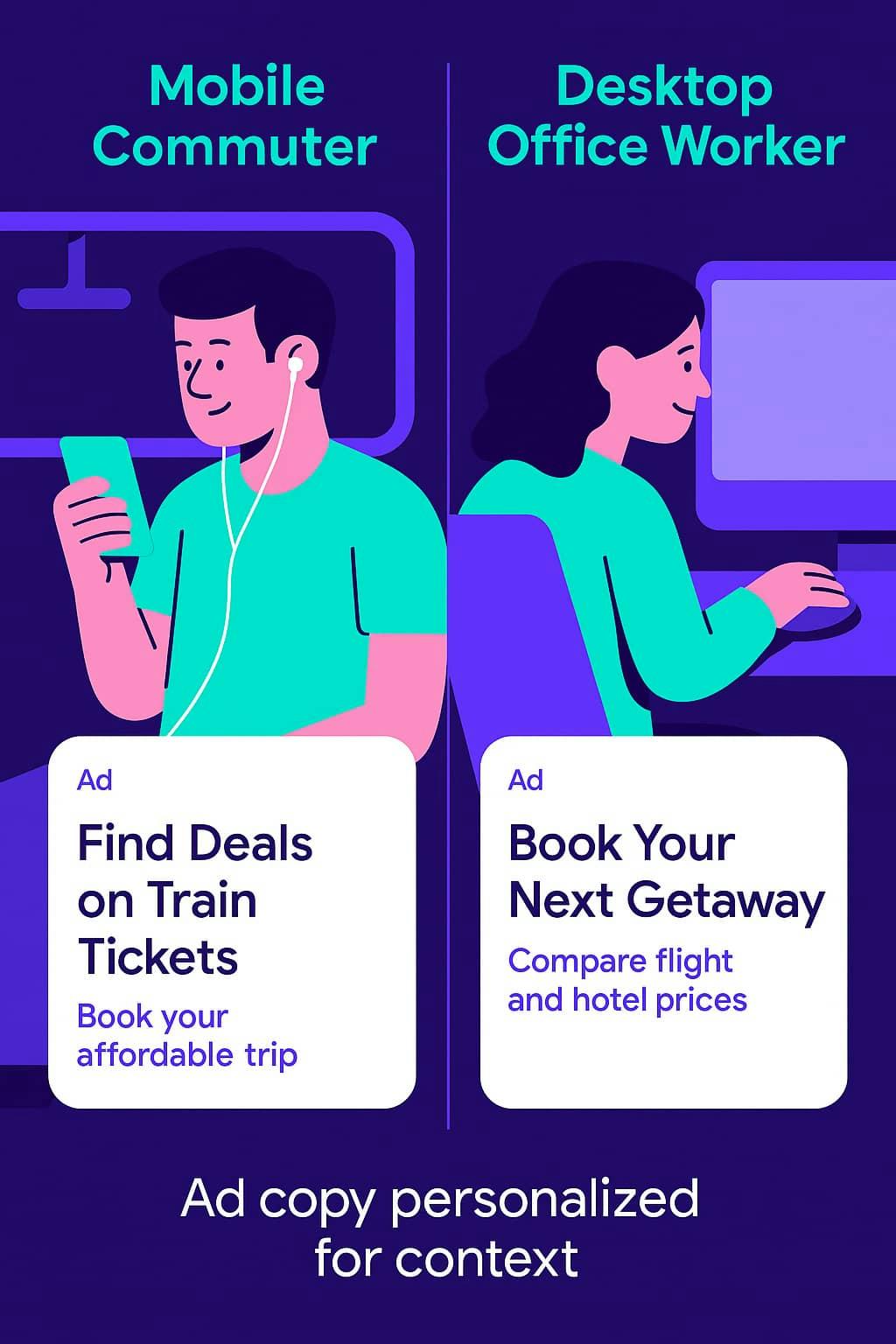
Knowing where people see your ads helps you make better messaging decisions. Mobile users on the move are in a different mindset from desktop users sitting at work, and your copy should reflect that. Learn what drives each audience's device choice and timing so you can improve your copy.
Consider the user's mindset. Search ads reach people with explicit intent who are actively looking for a solution, while social ads interrupt people who came for entertainment or connection. Test different elements to match these different mindsets and expectations.
Focus not only on what you want to say, but on what people are ready to hear at that moment. The most successful ad copy speaks to people in their own language, both demographically and emotionally.
Test systematically and at scale
Getting ad copy right takes a rigorous testing process. Many teams wait for 95% statistical confidence before declaring a winner, which helps avoid acting on flukes. Test one variable at a time so you can see what actually makes the difference.
Build out full testing calendars that account for seasons, business cycles, and other factors that could affect results. Document every test: write down your hypothesis, how you reached your results, and what worked and what didn't, so you learn from failures and avoid repeating them.
Remember: without proper statistical controls, testing is just guessing with extra work. Get it wrong, and the insights that could improve your results disappear.
Find the right balance of automation and manual contribution
Machine learning advertising tools are great at optimizing and personalizing, but they still need people to keep brand messaging consistent and creative ideas evolving. The best campaigns pair AI with human creativity and strategic thinking, so technology augments rather than replaces human capability.
Set policies for AI tools, including brand voice, messaging limits, and approval workflows for automated content. Keeping AI-generated copy accurate and up to date protects your brand values and keeps communication authentic.
Think of AI as a smart intern: fast and efficient at running tasks and sifting through data to spot patterns, but still needing you to direct the work, review it, and decide whether the results make business sense.
Focus on customer value over product features
Great ad copy focuses on benefits and outcomes more than features or specs. People don't buy products; they buy solutions to their problems. Focus on the difference your product makes in customers' lives, not on the nuts and bolts of how it works.
Rather, write like your customers write, not like your industry talks or like your product's technical specifications, and make sure every claim can be substantiated, as FTC policy requires. Speak directly and authentically to what people are struggling with or what they want.
Ask yourself "So what?" every time you write a claim. If you can't say why it matters to your customer, keep rewriting until you can.
Looking ahead: the future of advertising copy
Ad copy keeps changing with technology and customer preferences. AI-driven personalization is becoming table stakes rather than a differentiator, so marketers will need to stand out through an authentic brand voice and the value they deliver.
New thinking about marketing will shape how brands collect and use consumer data, with more focus on first-party relationships and value exchange. The brands that do this best will build direct relationships with customers based on experience, not on tracking and manipulation.
Voice and conversational AI will create new ways to interact with ads, and augmented reality and immersive technologies will bring "ad copy" into spaces that mix the physical and digital worlds. The next wave will see brands that are tech-savvy but keep a lasting human touch.
The brands achieving outsized returns, like Cosabella with its 336% bump in ROAS or Nike with its divisive but on-target brand campaign, show that in a crowded digital landscape, the companies that tell bold, authentic stories and then optimize them relentlessly are the ones winning.
Through all of this, one basic truth remains: great ad copy starts with knowing your market intimately, identifying specific wants and needs, and answering them with compelling solutions in a conversational, persuasive way. Technology supports these fundamentals; it doesn't replace them.
References:
- WebApex - Google Ads Conversion Rate & CPA By Industry [2025]
- WordStream - Google Ads Benchmarks for Your Industry
- AppsFlyer - Guide to Dynamic Creative Optimization in 2024
- USC - Psychology of Advertising
- Wharton - Psychology Behind Celebrity Endorsements
- Vanderbilt - Psychological Disorders and Consumer Behavior
- FTC - Advertising and Marketing Guidelines
- Retail TouchPoints - Cosabella Marketing Automation Case Study
- Marketing Dive - Cosabella AI Marketing ROI
- Adweek - Meta AI Ad Creation
- Search Engine Land - Google Ads Copy in 2024
- University of New England - Power of Persuasion
