什么是电子邮件送达率?完整指南
Here's the thing about email deliverability: in EmailToolTester's tests across 15 email service providers, the average deliverability rate was 83.1%, which means 16.9% of emails never reached the intended inbox. Every message that misses the inbox is a missed chance to earn revenue.
Whether you work for a startup or a Fortune 500 company, understanding email deliverability can make the difference between marketing that works and marketing that fails. This guide covers what you need to know to get your emails into the inbox.
Understanding Email Deliverability: The Complete Picture
Three factors work together to determine the fate of your email. First, delivery means your email reaches the recipient's mail server without bouncing. Second, inbox placement measures whether delivered emails land in the main inbox or the spam folder. Third, engagement tracking shows what recipients did with the emails they received.
Email deliverability works in layers of filtering. Inbox placement differs by provider: TrulyInbox's deliverability statistics lists 87.2% inbox placement at Google and 75.6% at Microsoft, citing Validity's Q1 2025 report. Gmail's filters, for example, are primarily based on machine learning, so tactics that worked yesterday may not work today.
Authentication protocols form the foundation of deliverability success. SPF confirms sending servers, DKIM gives certainty around the message's integrity, DMARC enables policy enforcement. These are not simply technical requirements, they are trust signals that major providers like Gmail and Yahoo require of bulk senders these days.
The Technical Foundation That Matters
Email authentication is no longer an option, but a must. Both Gmail and Yahoo have required authentication for bulk senders of 5,000-plus daily messages since February 2024. This change demonstrates the industry's determination when it comes to fighting spam and shielding the inboxes of people everywhere.
Sender reputation works at both the IP and the domain level. It rewards steady, long-term sending behavior and penalizes domain hopping and authentication inconsistencies. List practices matter too: Mailgun's State of Email Deliverability 2025 survey found that around 60% of senders conduct list hygiene regularly, but only 24% use sunset policies.
Content filtering goes beyond spam traps to evaluate HTML, image-to-text balance and CSS. Mailtrap lists too many images (more than 40% of the message content) among common spam triggers, along with broken HTML and missing unsubscribe links.
Current Email Deliverability Statistics and Trends
Deliverability varies widely across providers and industries. In GlockApps' Q4 2024 tests, counting only messages delivered to the inbox or spam, total average inbox rates were 51.97% for Gmail (accounts 6 months+), 33.23% for Yahoo and 32.27% for Outlook.
Industry performance is uneven too. TrulyInbox's roundup of Validity's 2025 benchmark data lists healthcare at 94.7% deliverability, software at an average of 80.9% and manufacturing at 82.2%. Gaps like these reflect differences in content, audience engagement patterns and technical maturity.
Mobile engagement shapes deliverability strategy as well. Porch Group Media's statistics roundup reports that mobile clients account for 41.6% of email opens, so mobile-friendly design supports the engagement signals that build sender reputation. Timing matters too: Omnisend's send-time research finds that Tuesday has the strongest top-of-funnel performance of the week, with a 31.27% open rate.
Provider-Specific Performance Insights
Microsoft has tightened its rules as well. From May 5, 2025, Outlook began applying authentication requirements to high-volume senders (more than 5,000 emails a day), following the earlier requirements from Gmail and Yahoo.
Apple's Mail Privacy Protection has shifted engagement measurement. Because MPP automatically loads email content, open rates are inflated, which makes common open-rate optimization techniques less reliable.
DMARC adoption is rising. In Mailgun's 2025 deliverability survey, nearly 54% of respondents said they had implemented DMARC, compared with less than 43% in 2023. Many senders still have work to do before their policies are fully enforced.
Real-World Examples and Case Studies
Deliverability work pays off because every message that reaches the inbox has a chance to earn revenue, while one that lands in spam does not. Authentication and engagement best practices are the foundation of that return.
Aggregate data can hide provider-specific problems. A brand can see healthy overall delivery while one mailbox provider routes its mail to spam, so monitor performance by provider instead of relying only on aggregate delivery metrics.
Common deliverability errors look similar across industries. Missing or incomplete authentication remains a frequent problem. Spam complaint rates at or above Gmail and Yahoo's 0.3% threshold put bulk senders out of compliance, and poor list hygiene compounds these issues.
Industry-Specific Challenges
E-commerce senders face extra pressure during peak holiday seasons, when sending volumes rise. Transactional emails such as order confirmations and shipping notices must arrive reliably, and B2B and B2C programs need different content strategies and authentication approaches.
Industry gaps like these, documented in TrulyInbox's statistics roundup, help marketers set realistic expectations and develop targeted improvement strategies.
Benefits and Strategic Uses of Email Deliverability
1. Revenue Protection and Growth
Good email deliverability directly affects bottom-line results through better campaign performance and customer retention. Higher inbox placement, stronger engagement and a healthier sender reputation all feed into revenue from email marketing.
The impact extends beyond individual campaigns. Consistent inbox placement improves sender reputation over time and creates a virtuous cycle. As Salesforce's deliverability guide defines it, "Email deliverability is the ability to deliver emails to your subscribers' inboxes," and it is a standard metric for judging email marketing effectiveness.
2. Enhanced Customer Experience and Trust
Email deliverability optimization directly improves customer experience by ensuring important communications reach recipients reliably. This reliability builds trust and strengthens brand relationships, particularly for transactional emails like order confirmations, shipping notifications, and account updates.
Consistent inbox placement reduces customer service inquiries about missing emails and prevents frustration from delayed communications. Many programs still fall short: DesignRush reports that 36% of email programs still struggle with authentication failures, citing its 2026 Email Marketing Benchmark Survey.
3. Competitive Advantage Through Technical Excellence
Organizations that master email deliverability are better placed as compliance requirements tighten across the industry. Early authentication adoption puts companies in good standing with mailbox providers while others struggle with implementation.
Technical competence in email marketing signals overall digital maturity to customers and business partners. That perception supports brand credibility, particularly in B2B environments where technical competence matters.
4. Operational Efficiency and Cost Reduction
Effective deliverability practices reduce operational costs through more efficient campaigns and fewer customer service issues. Higher inbox placement makes the most of your email marketing investment.
Automated authentication monitoring and deliverability testing catch mistakes before they affect campaigns. Mailgun's guide to spam complaint rates notes that Gmail and Yahoo hold the spam rate threshold at 0.3%, while many companies and providers already set a threshold of 0.1%, and it recommends aiming closer to 0.02%.
Essential Tools and Platforms
Major email marketing platforms offer integrated deliverability features. Klaviyo is widely used in e-commerce for its segmentation, Mailchimp is known for accessibility and ease of use, and ActiveCampaign appeals to automation-focused marketers.
Dedicated deliverability monitoring is essential for serious email marketers. GlockApps lets you find out where your email lands across Gmail, Outlook, Yahoo and other major ISPs, and offers free tests to start. Google Postmaster Tools is free and gives direct insight into how Gmail views your sending reputation.
For agencies and growth teams managing deliverability across multiple client domains, Warmy solves a problem that most monitoring tools don't fully address: building sender reputation before campaigns go live. New domains simply can't hit the ground running. They need a warm-up phase. Warmy handles this through AI-driven sequences that steadily increase sending volume while simulating authentic engagement signals, including opens, replies, and spam rescues, that inbox providers use to gauge trustworthiness.
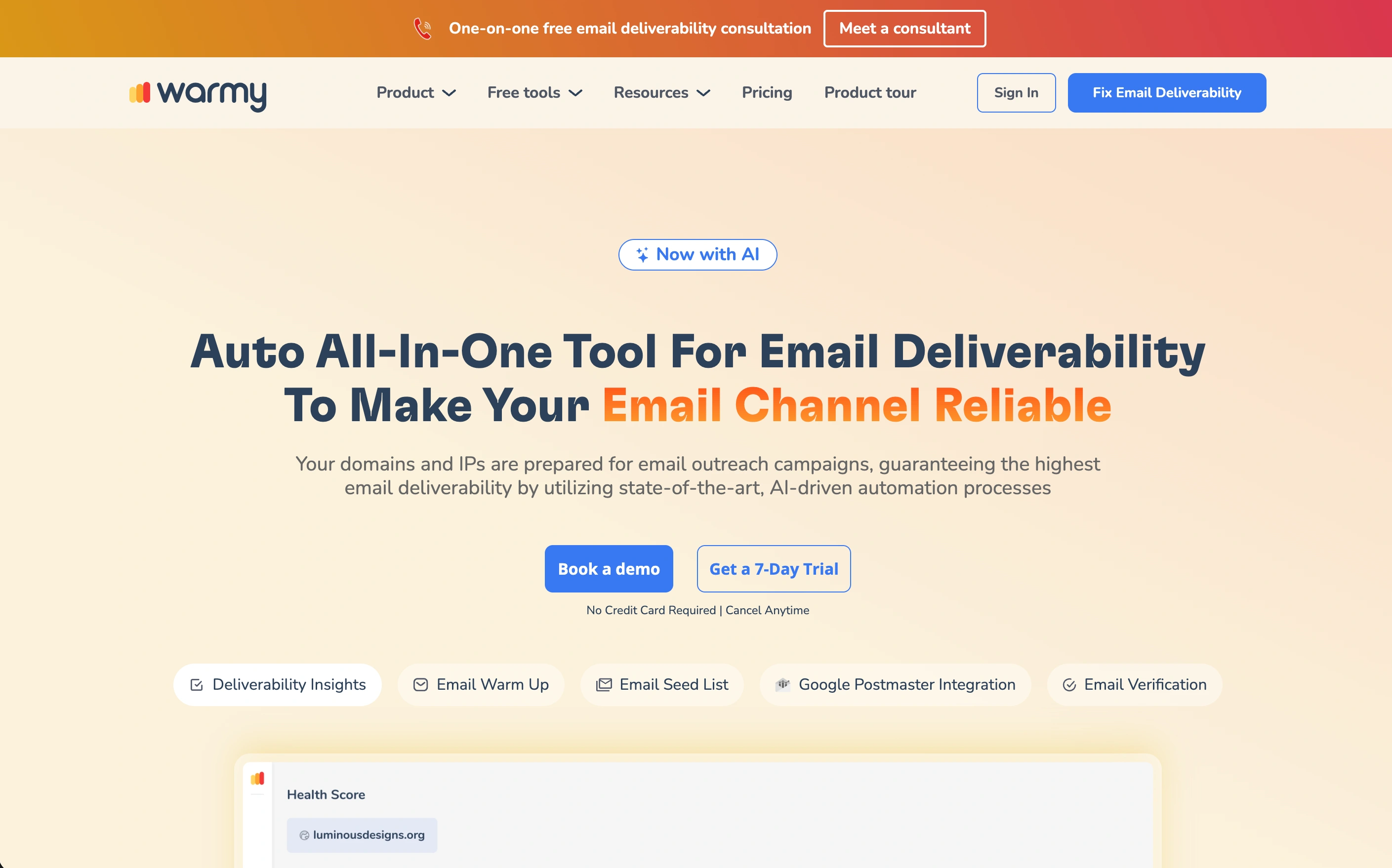
The platform goes well beyond warm-up. It includes inbox placement testing across major providers, a central domain health dashboard covering SPF, DKIM, and DMARC status, blacklist monitoring, and reputation scoring. Agencies managing campaigns across different geographies also benefit from its multi-language warm-up support, which is not common in competing tools. Multi-mailbox management lets teams handle several client domains from a single interface, cutting down the context-switching that usually slows deliverability audits. It's a practical option for anyone who treats warm-up and ongoing reputation monitoring as two sides of the same coin rather than separate tasks.
Authentication testing tools prevent costly implementation mistakes. MXToolbox checks SPF, DKIM and DMARC records, while services like PowerDMARC help enterprises manage authentication across multiple domains.
Emerging AI and Automation Solutions
Artificial intelligence is changing both content creation and deliverability work. TrulyInbox's statistics roundup reports that using AI in email marketing is helping increase click-through rates by 13.44%, citing a Validity report. Generic, obviously automated content can still hurt engagement, so personalization and value matter regardless of how the content is created.
i"Email deliverability has fundamentally evolved from a technical afterthought to the cornerstone of digital marketing success. Companies that master authentication, engagement, and privacy compliance don't just reach inboxes, they build sustainable competitive advantages that compound over time."
Tessar Napitupulu, Founder and CEO of Arfadia
Predictive deliverability scoring helps marketers assess inbox placement probability before sending. These systems analyze authentication status, content characteristics, list quality and historical performance to forecast delivery success.
Authentication Requirements and Implementation
Email authentication requires careful attention to technical details and ongoing monitoring. SPF records must list all authorized sending servers while staying under the 10 DNS lookup limit, as DesignRush's deliverability guide reminds senders; exceeding the limit makes SPF fail and causes immediate deliverability problems.
DKIM implementation involves generating cryptographic keys and publishing public keys in DNS records. DesignRush's guide recommends keys of at least 2048 bits, rotated at least once a year. Many organizations struggle with DKIM setup across multiple sending domains and third-party services.
DMARC policy implementation follows a gradual approach, starting with a "none" policy for monitoring, moving to "quarantine" for testing, and finally "reject" for full protection. EasyDMARC's research found that only 61% of top manufacturing companies had implemented DMARC, even though the World Economic Forum calls manufacturing the most targeted industry for cyber attacks over three consecutive years.
BIMI and Advanced Authentication
Brand Indicators for Message Identification (BIMI) displays brand logos directly in recipients' inboxes. Among the top 1 million domains, URIports' analysis counted BIMI records rising 28% between May 2024 and January 2025 (from 7,562 to 9,661 domains), yet 53.6% of BIMI domains had errors in 2025, with non-compliant SVG files the most common.
BIMI depends on DMARC at enforcement (quarantine or reject), so authentication work comes first.
Privacy Regulations and Compliance Impact
Privacy and anti-spam rules shape email marketing practices. Under CAN-SPAM, the FTC's CAN-SPAM compliance guide states that each separate violating email is subject to penalties of up to $53,088. GDPR adds further obligations for international email marketing.
Beyond California's CCPA, a growing number of US states have passed their own consumer privacy laws, adding compliance complexity for US businesses. These laws give consumers more rights over how their personal information is used, including in email marketing.
Apple's Mail Privacy Protection changed how engagement is measured. Open-rate optimization becomes less reliable because MPP pre-loads content regardless of actual user engagement. Smart marketers shift toward click-based metrics and multi-touch attribution for performance assessment.
Adaptation Strategies for Privacy-First Marketing
First-party data collection through interactive content and preference centers replaces invasive tracking methods. Progressive profiling, building subscriber profiles gradually across multiple touchpoints, respects privacy while keeping personalization possible.
Zero-party data collection through surveys, polls, and preference updates provides valuable insights while respecting privacy preferences. This approach builds trust with subscribers while gathering actionable data for personalization and segmentation strategies.
Best Practices and Expert Recommendations
List hygiene goes beyond basic bounce processing. Effective approaches combine real-time validation at signup, behavioral analysis and predictive modeling to spot disengagement risks. DesignRush's guide suggests engagement windows of 90 to 180 days for lapsed contacts before re-engagement or sunsetting.
Send time optimization has evolved from basic time zone adjustments to analysis of individual recipients. In Omnisend's 2026 send-time research, Tuesday shows the strongest top-of-funnel performance (a 31.27% open rate and a 0.81% click-to-sent rate), and sending between 9 AM and 11 AM is recommended for visibility.
Content optimization requires balancing personalization with deliverability. Keep HTML clean and image-to-text ratios balanced. Content filters examine all parts of a message, including headers, subject line, footer, links and images, as Mailtrap's guide to spam filters explains, so small details matter for inbox placement.
Technical Implementation Guidelines
IP warm-up for new senders typically takes four to six weeks of gradual volume increases, according to MailReach's guide to IP warm-up, which advises starting with a small share of your most engaged subscribers (no more than 5,000) before expanding to broader segments.
Domain reputation management requires consistent sending practices and authentication compliance. Organizations should avoid domain switching and maintain consistent From addresses to build long-term reputation value. Subdomain strategies can protect primary domains while testing new campaigns or audiences.
Frequently Asked Questions
What is the difference between email deliverability and delivery rate?
Email delivery rate measures emails that reach the recipient's mail server without bouncing, while deliverability encompasses inbox placement versus spam folder filtering. You can have 100% delivery but poor deliverability if emails consistently land in spam folders rather than primary inboxes.
How long does it take to improve email deliverability?
Minor issues such as authentication setup can be fixed relatively quickly, but severe reputation damage takes much longer to resolve. Consistent best practices and gradual volume increases help reputation recover and prevent future issues.
Why do my emails go to spam even with proper authentication?
Authentication is necessary but not sufficient for inbox placement. Content quality, engagement rates, list hygiene, and sender reputation all influence spam filtering decisions. Low engagement rates or high complaint rates can override authentication benefits and cause spam folder placement.
What's the ideal spam complaint rate for email campaigns?
Gmail and Yahoo require bulk senders to keep spam complaint rates below 0.3% (3 complaints per 1,000 emails), and Google's ideal is below 0.1%. Rates above the threshold can lead to rejections. Monitor complaints closely and remove complainers immediately to stay in good standing.
How does mobile optimization affect email deliverability?
Mobile optimization affects deliverability indirectly through engagement. With a large share of emails opened on mobile, a poor mobile experience leads to quick deletions and low engagement, and those negative signals can influence future inbox placement.
What authentication protocols are mandatory today?
Gmail and Yahoo require SPF, DKIM and DMARC for bulk senders of more than 5,000 emails a day, along with one-click unsubscribe and spam complaint rates below 0.3%. Microsoft's Outlook requirements for senders of more than 5,000 emails a day, in force since May 2025, also call for SPF, DKIM and DMARC and a visible unsubscribe link.
Can AI-generated content hurt email deliverability?
AI-generated content doesn't inherently harm deliverability when properly implemented. However, generic or obviously automated content may reduce engagement rates, which negatively impacts sender reputation. Focus on personalization and value regardless of content creation method.
Related Terms
- Email Marketing - Direct marketing using email to communicate with prospects and customers through targeted campaigns
- Marketing Automation - Technology automating repetitive marketing tasks that agencies use to scale client campaigns efficiently
- Customer Acquisition Cost (CAC) - Total cost of acquiring new customer including marketing and sales expenses
- Return on Investment (ROI) - Key performance metric agencies use to measure and demonstrate campaign profitability for clients
Conclusion
Email deliverability has moved from optional optimization to a business-critical requirement. Mandatory authentication, AI-powered filtering and stricter privacy rules call for approaches that balance technical compliance with genuine subscriber value.
The rewards for getting deliverability right are substantial: more of your emails reach the inbox and get the chance to drive revenue. Poor deliverability, by contrast, sets off a chain of problems through damaged sender reputation and rising acquisition costs.
Success requires three commitments: complete authentication, engagement quality over quantity, and continuous adaptation to changing requirements. Organizations that build robust, adaptable email programs today set themselves up for lasting results.
The question isn't whether to prioritize email deliverability, but how quickly you can put best practices in place. Start with authentication compliance, invest in proper monitoring tools, and build engagement-focused campaigns that respect subscriber preferences while driving business results.
References:
- EmailToolTester - Average Email Deliverability Rate in 2026
- TrulyInbox - Top 15 Email Deliverability Statistics in 2026
- GlockApps - Email Deliverability Statistics Q4 2024: Delivery Rates for Popular Inbox Providers and Senders
- PowerDMARC - Google and Yahoo Updated Email Authentication Requirements for 2026
- Mailgun - State of Email Deliverability 2025: Key Takeaways
- URIports Blog - BIMI: Updated Analysis of the Top 1 Million Domains
- EasyDMARC - Research: Only 61% of top manufacturers have adopted DMARC despite rising cyber attacks
- Omnisend - The best time to send an email (2026 research)
- Federal Trade Commission - CAN-SPAM Act: A Compliance Guide for Business
- Salesforce - What is Email Deliverability? Best Practices & Tips
- DesignRush - How To Improve Email Deliverability in 2026
- Porch Group Media - 100 Compelling Email Statistics for 2026
